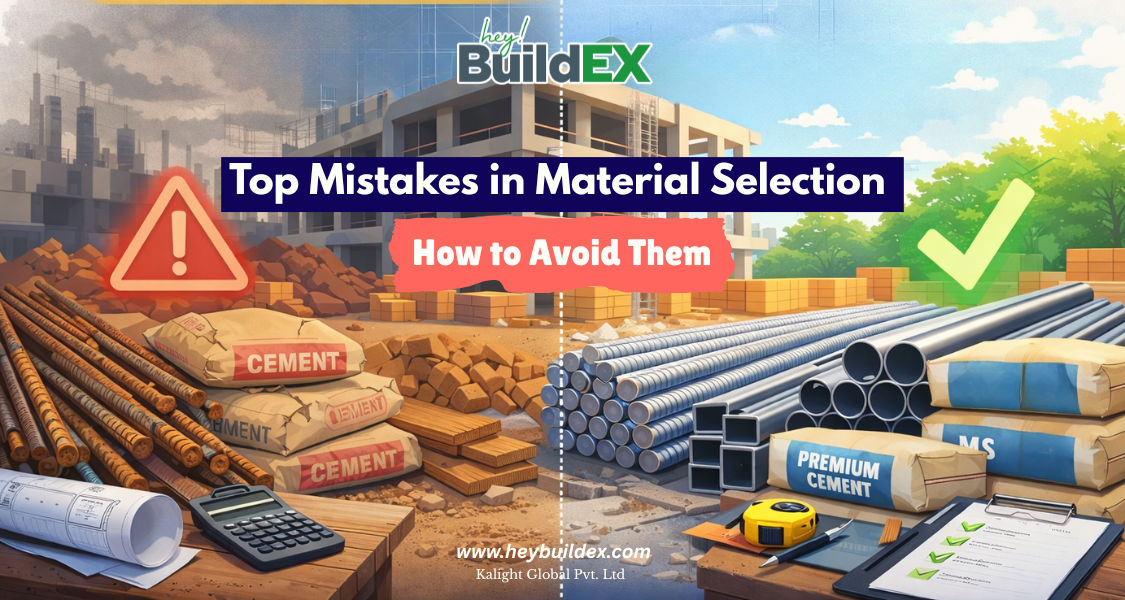
In construction and infrastructure development, every decision matters — but few carry as much weight as steel material selection. The steel you choose determines whether a structure stands for decades or develops costly problems within years. Wrong choices ripple across the entire project: they compromise structural safety, inflate lifecycle costs, trigger compliance failures, and accelerate deterioration.
From residential buildings to industrial plants and bridges, construction steel procurement is far more nuanced than simply ordering the cheapest available stock. Selecting the right TMT steel grades, ensuring materials meet IS standards, and matching specifications to site conditions require knowledge and diligence.
HeyBuildex, a trusted construction steel supplier in India, works with contractors, builders, and project managers every day to help them make informed, cost-effective, and compliant material choices. This guide identifies the most common — and costly — steel material selection mistakes and shows you exactly how to avoid them.
Steel is not a commodity where one grade fits all applications. The structural steel selection process must account for several interrelated factors:
A developer in Pune was constructing a G+5 residential complex. To cut costs, the procurement team substituted Fe 500D with Fe 415 without consulting the structural engineer, saving approximately ₹1.8 lakh on the TMT order. The engineer discovered the substitution only at the reinforcement inspection stage. All placed reinforcement had to be removed and replaced with the correct Fe 500D grade — a process that cost ₹8.4 lakh in labour, re-fabrication, and project delay (21 days of idle time for 60 workers). The final cost was nearly five times the original saving. The project also faced a compliance notice from the local municipal authority.
Lesson: TMT steel grade substitution without engineering sign-off is one of the most expensive shortcuts in construction procurement. The grade specified in structural drawings exists for a reason — it defines the load-bearing capacity of the structure.
| TMT Grade | Yield Strength (MPa) | Tensile Strength (MPa) | Elongation (%) | Best For |
|---|---|---|---|---|
| Fe 415 | Min. 415 | Min. 485 | Min. 14.5% | Small residential, low-rise |
| Fe 500 | Min. 500 | Min. 545 | Min. 12% | Mid-rise buildings, general construction |
| Fe 500D | Min. 500 | Min. 565 | Min. 16% | Seismic zones, ductile frames |
| Fe 550 | Min. 550 | Min. 585 | Min. 10% | Flyovers, high-rise, industrial |
A commercial building contractor in Visakhapatnam procured standard Fe 500 TMT bars for a G+7 structure located 800 metres from the Bay of Bengal coastline. Corrosion-resistant steel (CRS) was specified in the engineer's recommendation, but was skipped to reduce material cost by ₹4.2 lakh. Within 3.5 years of project completion, occupants reported visible rust staining on concrete surfaces and column cover spalling. A structural audit revealed active corrosion in 40% of the basement columns. Remediation cost: ₹37 lakh — nearly 9x the original saving — and the building was partially evacuated during repair work.
Lesson: Coastal and high-humidity environments demand corrosion-resistant steel as a baseline specification, not an upgrade. The environmental exposure class must be assessed before procurement begins, not after problems appear.
| Environment | Risk Factor | Recommended Steel | Additional Precaution |
|---|---|---|---|
| Coastal (within 50 km of sea) | High chloride-induced corrosion | Fe 500D CRS / Epoxy Rebar | Increase concrete cover to 50mm+ |
| Industrial Zone | Chemical fumes, acid rain | CRS / Galvanised Steel | Use protective coatings |
| High Humidity Inland | Moisture accelerates oxidation | Fe 500D / Fe 500 with coating | Proper storage on-site |
| Seismic Zone III-V | High dynamic stress demand | Fe 500D (mandatory) | Verify ductility certification |
| Normal Inland (dry) | Standard oxidation | Fe 500 / Fe 415 | Standard cover and curing |
The temptation to go with the lowest quote is understandable — construction budgets are tight. But in steel procurement, price and value are very different things. Cheaper steel often means lower tensile strength, inconsistent chemical composition, or absent certifications. When that steel is embedded in a structure, fixing the problem later is exponentially more expensive than buying quality the first time.
Key Insight: As demonstrated in Case Study #2 above, a saving of ₹4.2 lakh led to a remediation bill of ₹37 lakh. The cheapest invoice is rarely the most cost-effective decision.
How to avoid it: Evaluate steel price vs quality by comparing total cost of ownership, not just unit cost. Request material test certificates and factor in lifecycle durability. A cost-effective steel supplier is one that offers competitive pricing alongside verified quality.
| Factor | Cheap / Uncertified Steel | ISI Certified Quality Steel |
|---|---|---|
| Upfront Cost (per MT) | Lower by 5–10% | Market standard |
| Expected Service Life | 8–15 years (unverified) | 30–50+ years |
| Corrosion Risk | High — no guaranteed composition | Low — IS 1786 compliant |
| Maintenance Cost (10 yrs) | High (repairs, rework) | Minimal |
| Legal & Compliance Risk | High — no documentation | None — fully documented |
| Total Cost of Ownership | HIGHER over project life | LOWER over project life |
TMT (Thermo-Mechanically Treated) steel comes in multiple grades — Fe 415, Fe 500, Fe 500D, and Fe 550 — each with different yield strength and ductility characteristics. Choosing the wrong grade for your application is a structural risk, as shown in Case Study #1.
TMT steel grades for construction must match structural engineering specifications — refer back to the grade comparison table above when selecting.
How to avoid it: Always refer to your structural engineer's drawings and specifications. Confirm the required grade before placing any order. HeyBuildex supplies all standard TMT grades and can help verify which grade is appropriate for your project type.
The ISI mark (administered by the Bureau of Indian Standards) indicates that the material has been tested and conforms to the relevant BIS standard — IS 1786 for TMT bars, IS 2062 for structural steel. Non-ISI certified steel carries serious risks: inconsistent mechanical properties, substandard chemical composition, and liability in the event of structural failure.
In many government and infrastructure projects, ISI certified steel is a contractual and legal requirement. Procuring non-certified steel for these projects creates compliance exposure that can halt work entirely.
How to avoid it: Insist on ISI certified steel from your supplier. Ask to see the BIS licence number and verify it on the BIS portal. When you source from a reputable ISI certified steel supplier like HeyBuildex, certification is a standard part of the documentation provided with every supply.
Coastal corrosion is one of the most damaging and underestimated factors in steel selection. Structures within 5–50 km of the sea are exposed to salt-laden air that dramatically accelerates oxidation. Industrial environments introduce chemical exposure. High-humidity inland zones also create elevated corrosion risk.
Selecting standard TMT bars for these conditions without specifying corrosion-resistant steel — such as Fe 500D CRS or epoxy-coated rebar — results in accelerated degradation, as seen in the Visakhapatnam case above.
How to avoid it: Assess the site's environmental exposure class before specifying steel. Refer to the environmental condition table included earlier in this guide for grade recommendations by zone.
A Mill Test Certificate (MTC) is the primary document that validates the properties of a specific batch of steel. It records chemical composition, tensile strength, yield strength, elongation, and bend test results — all verified at the manufacturing stage.
Many buyers accept steel without requesting or reviewing the MTC. Without an MTC, there is no way to verify that what was delivered matches what was specified. This is particularly common in informal procurement channels.
How to avoid it: Make it a standard practice to request the Mill Test Certificate for every supply. Cross-check the heat number on the MTC against the actual steel bundle. A credible supplier will always provide this documentation without hesitation.
Structural steel comes in a wide range of sections — MS beams (I-beams, H-beams), angles, channels, flat bars, and plates — each with specific load-bearing characteristics. Specifying the wrong section size leads to either over-engineering (wasteful cost) or under-engineering (structural risk).
Load miscalculations are common when buyers rely on estimations rather than structural analysis. Replacing a specified 200mm x 100mm MS beam with a 150mm x 75mm alternative to save cost changes the load distribution of the entire frame.
How to avoid it: Refer to your structural design drawings for section specifications. Do not substitute sizes without engineering approval. Consult your supplier's technical team to confirm that available stock matches project requirements exactly.
Steel procurement is not just about what you buy — it is about when it arrives. Construction timelines are sequential; delayed steel supply halts multiple downstream activities simultaneously. Labour sits idle, equipment hire continues, and project cost escalation follows quickly.
Buyers who choose suppliers based on price alone often discover that cheaper suppliers have less reliable inventory, longer lead times, or poor logistics infrastructure. The cost savings evaporate the moment a delivery is delayed by two weeks.
How to avoid it: Evaluate supply reliability as a core selection criterion alongside price and grade. Ask prospective suppliers about stock levels, delivery lead times, and their track record. HeyBuildex maintains robust stock and logistics infrastructure to protect your project timeline.
Construction projects involve complex material interdependencies. Steel choice affects concrete mix design, connection detailing, fire protection requirements, and long-term maintenance. Making procurement decisions without engineering input — or without consulting your supplier's technical team — increases the risk of costly mismatches.
How to avoid it: Engage your structural engineer early and maintain communication through the procurement stage. Choose a steel supplier that offers genuine technical guidance. Site-specific recommendations — accounting for load conditions, seismic zone, climate, and project type — should inform every material decision.
HeyBuildex was built around one principle: buyers deserve accurate information, certified materials, and a supplier they can trust. Here is how HeyBuildex supports better material decisions:
Every structural decision starts with the right material selection. Don't leave it to chance.
Consult your structural engineer, verify certifications, request test documents, and partner with a steel supplier who brings knowledge alongside inventory. HeyBuildex is ready to help you make the right call — from grade selection and compliance checks to reliable, on-time delivery.
The most common mistake is choosing steel based solely on price without verifying quality, certification, or suitability. This often leads to procuring non-ISI certified or incorrect grade steel that increases lifecycle costs and creates structural risk. Evaluating total cost of ownership — not just unit price — is essential to making a sound decision.
Look for the ISI mark physically on the steel product, which includes the BIS logo and the relevant IS number (e.g., IS 1786 for TMT bars). You can verify the supplier's BIS licence number on the official BIS portal (bis.gov.in). Always ask your supplier to provide certification documentation alongside the Mill Test Certificate.
Fe 500 and Fe 500D are the most commonly recommended TMT steel grades for residential construction in India. Fe 500D offers superior ductility, making it the preferred choice in seismic zones. For smaller low-load structures, Fe 415 may be adequate — but this must be confirmed by a structural engineer based on the specific design and zone requirements.
Yield strength defines the maximum stress a steel bar can withstand before it begins to deform permanently. In structural applications, steel that reaches its yield point under design loads will deform, compromising the integrity of the structure. Matching yield strength to design loads — as specified by your structural engineer — is fundamental to ensuring safety and IS compliance.
Coastal salt air, industrial pollution, and high humidity significantly accelerate steel corrosion. As demonstrated in the Visakhapatnam case study, standard TMT steel can deteriorate rapidly in high-exposure environments. Specifying corrosion-resistant steel grades and ensuring adequate concrete cover are critical steps that must be addressed at the procurement stage.
You should request: the Mill Test Certificate (MTC) confirming chemical and mechanical properties; the BIS certification or ISI licence number; delivery challan and invoice with heat number matching the MTC; and any additional test reports for corrosion resistance if applicable. A reliable steel supplier will provide these as a matter of course.
Evaluate suppliers on certification credentials, product range, documentation practices, delivery track record, and technical support capability. A reliable steel supplier in India should carry ISI certified stock, provide MTC with every supply, offer transparent pricing, and have the logistics infrastructure to meet your delivery timelines. References and physical verification of warehouse capacity are also strong indicators.
Total cost of ownership (TCO) in steel procurement includes the upfront purchase price plus all downstream costs: installation, maintenance, repairs due to corrosion or failure, and eventual replacement. As shown in both case studies above, a lower upfront price frequently results in a higher TCO when the steel is of inferior quality. Evaluating TCO rather than unit price alone leads to significantly better long-term value.