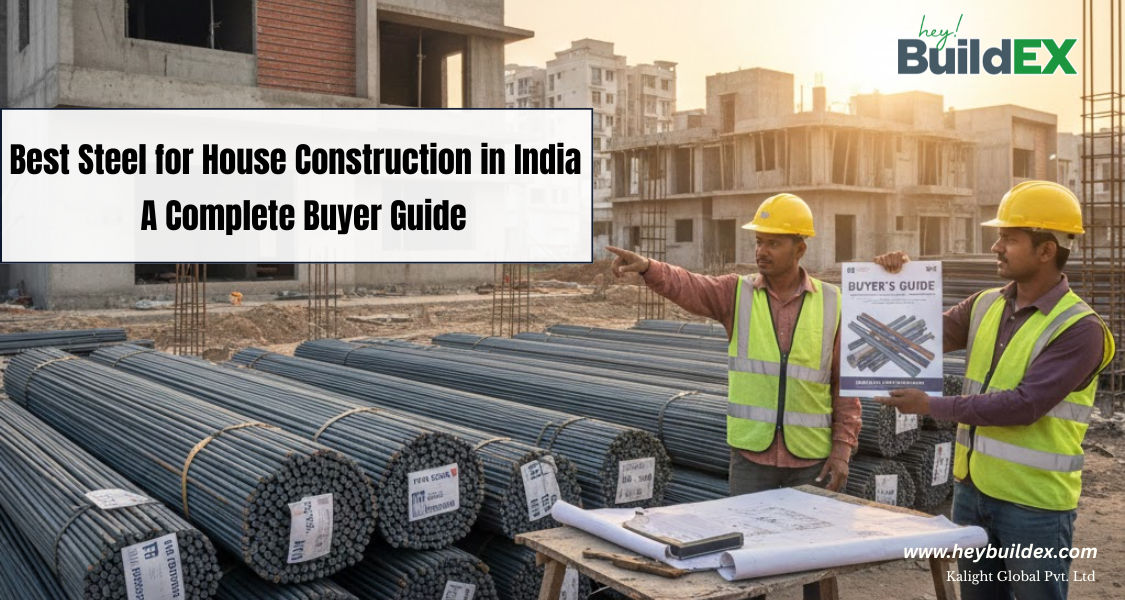
Building a house is often the biggest investment of a lifetime. While designs, finishes, and interiors get a lot of attention, the real strength of your home lies inside the concrete—in the steel you choose.
If you're a homeowner or residential builder asking:
This guide is written for you—to help you make a safe, informed, and future-proof decision.
Steel is the backbone of every RCC (Reinforced Cement Concrete) house. The quality of steel directly impacts:
Using the best quality steel for building a house is not an expense—it's a long-term safety investment.
TMT (Thermo-Mechanically Treated) bars are the primary reinforcement steel for residential buildings.
Used in:
👉 For most homes, TMT bars decide 80–90% of structural strength.
Used for:
Examples:
General term often used for:
Best overall choice for residential buildings
Key features:
Ideal for:
Higher strength but lower flexibility
Key features:
Mainly used in: high-rise & heavy-load structures
Ideal for:
| Parameter | Fe 500 TMT | Fe 550D TMT |
|---|---|---|
| Strength | High | Very High |
| Ductility | Excellent | Moderate |
| Earthquake safety | Better | Lower |
| Crack resistance | High | Medium |
| Suitability for homes | ✅ Best | ⚠️ Not ideal |
| Cost | Balanced | Higher |
👉 Verdict: For residential construction, Fe 500 / Fe 500D is the best TMT steel for house construction.
| Feature | TMT Bars | Normal Steel |
|---|---|---|
| Manufacturing | Thermo-treated | Hot rolled |
| Strength | High tensile | Low |
| Ductility | Excellent | Poor |
| Earthquake resistance | Yes | No |
| Corrosion resistance | High | Low |
| Lifespan | 40–60+ years | 10–15 years |
👉 Never use normal steel rods for house construction.
Ensures: Better load distribution, Thinner sections with same strength
Crucial for: Earthquake resistant steel for houses, Absorbing shock and movement without failure
Indian homes face: Humidity, Monsoon rains, Coastal air (in AP, TN, Kerala)
Corrosion resistant steel for homes prevents rusting inside concrete.
Good TMT bars have: Proper rib patterns, Strong steel–concrete bonding, Reduced slippage
High corrosion risk. Use high-quality Fe 500D with proven corrosion resistance
Andhra Pradesh, Telangana, North India. Prefer ductile steel with higher elongation
Avoid cheap or unbranded steel. Moisture accelerates internal rusting
Before buying, always check:
| RCC Component | Recommended Steel |
|---|---|
| Foundation | Fe 500 TMT |
| Columns | Fe 500 / Fe 500D |
| Beams | Fe 500 |
| Slabs | Fe 500 |
| Staircase | Fe 500 |
| Lintels | Fe 500 |
👉 Uniform grade across structure ensures consistent performance.
👉 These mistakes can cause cracks, corrosion, and safety issues within 5–10 years.
Before finalizing steel, ensure:
The best steel for residential construction is not the cheapest—it's the one that ensures:
For most Indian homes, Fe 500 / Fe 500D TMT bars from trusted suppliers are the smartest choice.
👉 When in doubt, consult a reliable steel supplier or structural expert before purchasing—because steel mistakes are permanent.
Fe 500 or Fe 500D TMT bars are best for RCC residential buildings due to strength and ductility.
Fe 500D is safer because it offers better flexibility and earthquake resistance.
Yes, especially in coastal and humid regions. Corrosion weakens steel silently inside concrete.
Choose BIS-certified, reputed brands with consistent quality and proper embossing. Brand reliability matters more than price.
Not recommended. Using the same grade throughout ensures uniform structural behavior.
Not always. Ductility and corrosion resistance matter more than just strength for long-lasting homes.
With proper grade and construction, 40–70+ years without structural issues.