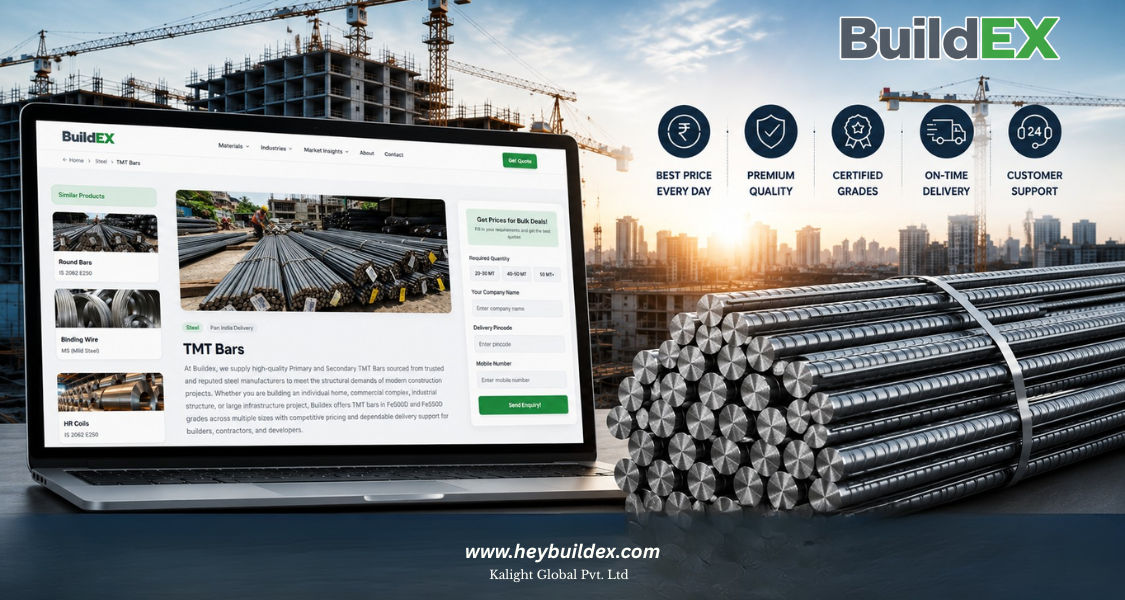
Sourcing steel has traditionally meant visiting multiple dealers, collecting handwritten quotes, and comparing prices with little documentation to fall back on. That's changing. Home builders, contractors, civil engineers, and procurement teams can now request quotations, compare specifications, and track orders from a desk or site office — a shift that's especially useful for infrastructure companies and contractors juggling several sites at once.
This shift doesn't remove the need for diligence, though. Whoever is placing the order should still weigh grade, diameter, quantity, applicable certification, price, supplier credibility, freight terms, and delivery timelines — rather than picking whoever quoted the lowest number. The sections below walk through each of these factors in turn.
TMT stands for Thermo-Mechanically Treated. TMT bars are reinforcement steel bars manufactured through a process that combines controlled hot rolling with rapid water quenching and self-tempering. The outer surface of the bar is hardened while the core remains comparatively softer and more ductile.
This two-layer structure is what gives TMT steel bars their characteristic combination of high tensile strength and good ductility — the ability to bend and absorb stress without becoming brittle or snapping. That combination is why TMT bars , rather than plain reinforcement rods, are the standard choice of steel reinforcement bars for RCC (Reinforced Cement Concrete) construction across residential, commercial, and infrastructure projects in India.
In an RCC structure, concrete handles compressive load well but is weak under tension. TMT construction steel is embedded within the concrete to carry the tensile load, which is what allows beams, columns, slabs, and foundations to resist bending, seismic movement, and long-term structural stress.
Online procurement of construction steel has grown alongside broader B2B e-commerce adoption in India's building materials sector. It offers real advantages, but it works best when buyers understand both what it improves and what it does not automatically guarantee.
It's worth noting that buying online does not automatically mean a lower price. Total cost depends on material price, freight distance, order quantity, and market conditions at the time of purchase, so comparing landed cost — not just the quoted rate per kg — remains essential.
TMT bar grades — commonly Fe 500, Fe 500D, Fe 550, and Fe 550D — differ in strength, ductility, and suited applications. The "Fe" number indicates minimum yield strength in N/mm², while the "D" suffix denotes a grade with enhanced ductility and lower carbon content, which improves weldability and seismic performance.
| Grade | Strength | Ductility | Typical Applications |
|---|---|---|---|
| Fe 500 | High yield strength; widely used baseline grade | Moderate ductility | General residential and low-rise RCC construction |
| Fe 500D | High yield strength, similar to Fe 500 | Higher ductility than Fe 500; better elongation | Structures requiring better seismic and impact performance |
| Fe 550 | Higher yield strength than Fe 500 | Lower ductility than the "D" grades | Heavier structural sections where higher strength is specified |
| Fe 550D | Higher yield strength with improved ductility | High ductility and elongation | High-rise buildings, seismic zones, industrial and infrastructure structures |
The right grade for a given project depends on the structural design, the applicable Indian standards, and the specifications issued by the project's structural engineer — not on a generic recommendation. A common search question is which TMT grade is best for house construction; in practice, many residential structures use Fe 500 or Fe 500D , but the final decision should always follow the structural drawing and the engineer's specification for that specific building, soil condition, and seismic zone.
TMT bars are supplied in standard diameters, each suited to different structural elements. Commonly used sizes include 8 mm, 10 mm, 12 mm, 16 mm, 20 mm, 25 mm, and 32 mm.
| TMT Size | Approx. Weight per Meter (Theoretical) | Common Construction Use |
|---|---|---|
| 8 mm | ≈ 0.395 kg/m | Stirrups, ties, and light reinforcement in slabs |
| 10 mm | ≈ 0.617 kg/m | Slabs, lintels, and secondary reinforcement |
| 12 mm | ≈ 0.888 kg/m | Columns, beams, and general RCC work |
| 16 mm | ≈ 1.578 kg/m | Beams and columns in residential and mid-rise construction |
| 20 mm | ≈ 2.466 kg/m | Columns and beams in larger structures |
| 25 mm | ≈ 3.853 kg/m | Heavy columns and structural elements in high-rise/industrial builds |
| 32 mm | ≈ 6.313 kg/m | Major structural members in large infrastructure projects |
These figures are standard theoretical weights derived from the bar's cross-sectional area and steel density, and are commonly used for estimation and billing reference. Actual delivered weight can show minor, permissible variation from theoretical weight depending on manufacturing tolerances, so buyers verifying a bulk delivery should check the actual weighment slip against the purchase order rather than relying on theoretical figures alone.
TMT bar pricing online is usually quoted per kg or per ton, but the quoted material rate is only one part of the total cost. A meaningful price comparison has to account for taxes and delivery-related charges as well.
Total Landed Cost = Material Cost + Applicable Taxes + Freight + Other Applicable Charges
A supplier quoting the lowest per-kg rate is not necessarily the most cost-effective choice once freight, loading charges, and taxes are added. Two suppliers offering the same TMT bar price per kg can end up with different landed costs simply because of where they are located relative to the delivery site. Buyers evaluating options to buy TMT steel online should always request an all-inclusive landed cost quotation before comparing suppliers.
Confirm that the grade mentioned in the online quotation matches what the project's structural design specifies, before placing the order.
TMT bars manufactured and sold in India are expected to conform to applicable Indian standards. Ask the supplier to confirm the certification status relevant to the product being purchased.
Knowing the manufacturer behind the bars — rather than just the trading supplier — helps with traceability and gives the buyer a documented paper trail for the project.
TMT bars are typically embossed with markings that can help identify the manufacturer, grade, and standard. These markings are a quick visual reference during delivery inspection.
Measure and weigh a sample from the delivered batch and compare it against the purchase order specification and standard theoretical weight.
Material test certificates, where available, provide documented evidence of the mechanical properties of the batch and are useful for project quality records and audits.
Look for excessive rust, visible cracks, bends, or deformation on delivered bars. Minor, superficial surface discoloration from storage or transit does not, by itself, mean the steel is unusable — but pitting, flaking, or structural deformation should be flagged with the supplier.
Bulk procurement needs differ across project types — residential builds, apartment complexes, commercial buildings, warehouses, industrial structures, and infrastructure projects each have distinct consumption patterns and delivery schedules.
For bulk buyers, a reliable tmt bar supplier online should be evaluated on more than price alone:
An online steel supplier that can support staged deliveries and maintain consistent documentation across multiple dispatches is generally better suited to large or phased projects than one offering a single lowest-price quote.
Note: The figures below are illustrative examples for explanation purposes only and do not represent live market rates.
Consider a homeowner constructing a two-storey house. Working with their structural engineer, they estimate a requirement of roughly 3 tonnes of TMT bars across 8 mm, 10 mm, 12 mm, and 16 mm sizes, largely in Fe 500D grade.
In this illustrative scenario, if Supplier A quotes ₹58/kg with free delivery and Supplier B quotes ₹56/kg plus ₹1.5/kg freight, the effective landed rate for Supplier B (₹57.5/kg) is still marginally lower — but the gap is far smaller than the initial per-kg quote suggested, which is exactly why landed cost comparison matters even for smaller residential orders.
Note: All figures below are illustrative examples only, used to demonstrate the calculation method, not current market prices.
A contractor needs 25 tonnes of Fe 500D TMT bars for an apartment project and obtains quotes from two suppliers.
| Component | Supplier A | Supplier B |
|---|---|---|
| Quoted price | ₹55/kg | ₹53.5/kg |
| Quantity | 25,000 kg | 25,000 kg |
| Material cost | ₹13,75,000 | ₹13,37,500 |
| GST (illustrative 18%) | ₹2,47,500 | ₹2,40,750 |
| Freight (illustrative) | ₹15,000 | ₹45,000 |
| Total landed cost | ₹16,37,500 | ₹16,23,250 |
Even though Supplier B has higher freight due to a longer delivery distance, its lower base price still results in a lower total landed cost in this example. This is the calculation contractors should run for every genuine bulk quotation, rather than comparing the headline per-kg figure alone.
Once an order is confirmed, the supplier typically allocates stock against the order, plans dispatch based on truck and route availability, and arranges loading. From there, delivery to the project site is scheduled, followed by quantity verification and handover of documentation such as the invoice and weighment slip.
Delivery timelines can vary meaningfully based on:
Sourcing and delivery considerations for online TMT bar orders can vary across South India's key construction markets, including Visakhapatnam, Vijayawada, Amaravati, Hyderabad, Guntur, Kakinada, Rajahmundry, Tirupati, and Nellore.
Availability of specific grades and sizes, freight cost, and delivery timelines are not uniform across these locations — they depend on each supplier's depot network and proximity to the project site. A buyer in Vijayawada may see faster turnaround for common sizes than a buyer in a location further from a stocking point, simply due to logistics rather than product quality. It's worth confirming location-specific delivery timelines directly with the supplier before finalising an order.
A structured evaluation framework helps buyers compare potential suppliers on more than price.
| Factor | What to Check |
|---|---|
| Product Quality | Grade accuracy, applicable standards, and supporting documentation |
| Pricing | Per kg/ton rate plus a genuine landed cost comparison |
| Availability | Stock of the required sizes and quantity |
| Delivery | Coverage of the project location and realistic timeline |
| Transparency | Clarity of quotations, invoices, and communicated terms |
| Support | Responsiveness and assistance through the order process |
| Bulk Capability | Ability to fulfil large-volume or phased orders reliably |
Suppliers who score consistently across these factors — not just on the lowest quoted rate — tend to be more dependable partners for repeat sourcing, particularly for contractors and procurement teams handling multiple projects.
Buildex supplies steel and construction materials across South India, with a product range that includes TMT bars, structural steel, HR coils and HR sheets, MS beams, MS channels, MS angles, MS pipes, along with aluminium and copper products.
Buildex serves buyers across Visakhapatnam, Vijayawada, Amaravati, Hyderabad, and other locations in Andhra Pradesh and Telangana, working with contractors, builders, and procurement teams on both individual project orders and ongoing bulk supply requirements. Specifications, quotations, and documentation can be discussed directly with the Buildex team to match a project's grade, size, and delivery requirements.
Yes. Many registered steel suppliers now accept online enquiries and quotation requests for TMT bars, with material delivered to the project site. Buyers should still verify supplier credibility, grade, and documentation before confirming an order.
It can be, provided the supplier is verifiable, offers proper documentation, and the buyer confirms grade, certification, and quantity before and after delivery. As with any procurement, due diligence on the specific supplier matters more than the channel itself.
Compare the total landed cost — material price plus GST, freight, and loading charges — rather than just the quoted rate per kg. Two suppliers with similar per-kg prices can have different landed costs depending on delivery distance.
There is no single answer for every house. Many residential projects use Fe 500 or Fe 500D, but the correct grade depends on the structural design and the specification issued by the project's engineer.
Confirm the grade, diameter, and quantity required, verify the supplier's credibility and certification, and request an all-inclusive landed cost quotation covering material, tax, and freight before placing the order.
Yes, many suppliers handle bulk and phased orders for construction projects. Bulk buyers should confirm supply consistency, delivery scheduling, and price validity, since large orders can span several weeks.
After order confirmation, the supplier allocates stock, plans dispatch and loading, and delivers to the project site. The buyer should verify quantity and documentation at the point of delivery.
Use the formula: Total Landed Cost = Material Cost + Applicable Taxes + Freight + Other Applicable Charges. This gives a realistic comparison figure across different supplier quotations.
Check the grade against the specification, confirm applicable certification, inspect bar markings, verify diameter and weight, request test certificates where available, and inspect the surface condition on delivery.
Both are high-strength TMT grades, but Fe 500D has enhanced ductility and lower carbon content compared to Fe 500, which generally improves elongation, weldability, and performance under seismic or impact loading.