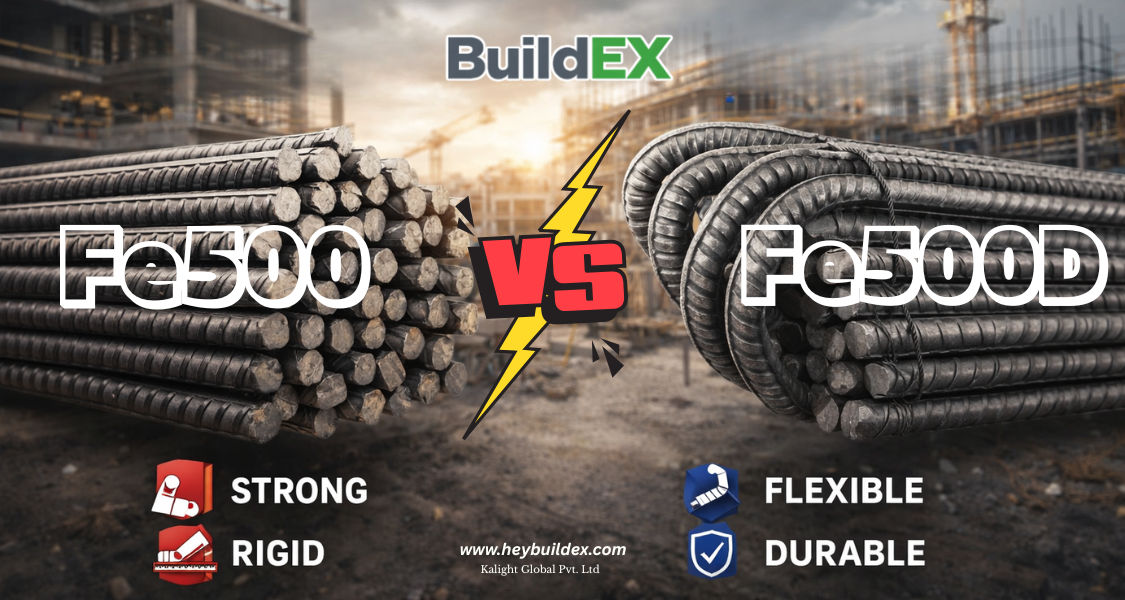
TMT bars — short for Thermo-Mechanically Treated bars — are high-strength reinforcement steel bars used as the backbone of modern construction. They are also known regionally as TMT rods, TMT saria, or reinforcement steel bars.
TMT steel is made by rapidly quenching hot-rolled steel rods in water, creating a tough outer martensite layer and a softer ferrite-pearlite core. This unique structure gives TMT bars both high strength and remarkable flexibility — a rare combination in construction materials.
In reinforced concrete structures, steel bars and concrete work together — concrete resists compression, while TMT steel bars resist tension forces. Without quality TMT bars, a building is structurally incomplete.
Why choosing the right TMT bar grade matters: The grade directly determines how your structure responds to loads, earthquakes, and the test of time. A wrong grade decision can mean under-built structures or unnecessary overspending. High-quality TMT bars from a certified source protect your investment for decades.
Both grades fall under IS:1786 — India's Bureau of Indian Standards specification for high strength deformed steel bars. The prefix "Fe" denotes iron (ferrum), and "500" refers to the minimum yield strength of 500 N/mm².
The letter "D" in Fe 500D stands for ductility. It has stricter chemical composition controls — lower carbon, sulphur, and phosphorus — which translate to better bending behavior and resistance to sudden fracture under dynamic loads.
| Minimum Yield Strength | 500 N/mm² |
| UTS / YS Ratio | ≥ 1.08 |
| Minimum Elongation | 12% |
| Maximum Carbon % | 0.30% |
| Max Sulphur + Phosphorus | 0.075% |
| Best For | General construction |
| Minimum Yield Strength | 500 N/mm² |
| UTS / YS Ratio | ≥ 1.15 |
| Minimum Elongation | 16% |
| Maximum Carbon % | 0.25% (lower is better) |
| Max Sulphur + Phosphorus | 0.050% |
| Best For | Earthquake-resistant structures |
Here is a clear, side-by-side comparison of both TMT steel bar grades based on the most important performance and composition parameters:
| Feature | Fe 500 | Fe 500D |
|---|---|---|
| Minimum Yield Strength | 500 N/mm² | 500 N/mm² |
| Tensile Strength | High | High |
| Ductility | Medium | Very High ★ |
| Elongation (Min.) | 12% | 16% ★ |
| UTS / YS Ratio | ≥ 1.08 | ≥ 1.15 ★ |
| Max Carbon % | 0.30% | 0.25% ★ |
| Weldability | Good | Better ★ |
| Earthquake Resistance | Moderate | Excellent ★ |
| Cost | More affordable ★ | Slightly higher |
| Best Use Case | General construction | Seismic zones & high-rise |
| IS Standard | IS:1786 | IS:1786 (stricter) |
In simple terms: Both grades offer the same yield strength. Fe 500D is not "stronger" — it is more flexible and safer under extreme stress. Think of it like a tree in a storm: a brittle branch snaps, but a flexible one bends and survives.
Fe 500 TMT bars are the most widely used reinforcement steel bars in India for standard construction. Here's why builders and contractors rely on them:
Fe 500D is the preferred choice for safety-critical and earthquake-resistant construction. Its superior ductility and tighter composition controls make it stand apart:
Choosing the best TMT bar in India for your specific project depends on the structure type, location (seismic zone), and budget. Here's a practical project-by-project guide:
🏠 Residential Construction
Fe 500
Budget-friendly choice for G+2 or G+3 homes in low seismic zones (Zone I & II). Delivers sufficient strength for standard residential load conditions.
Fe 500D
Safer option, especially in seismic zone III and above. Highly recommended for long-term durability and safety. The marginal cost difference is worth every rupee.
🏢 Commercial / High-Rise Buildings
Fe 500D
Strongly recommended for multi-storey buildings, IT parks, malls, hospitals, and structures where occupant safety is paramount. Many structural engineers make Fe 500D mandatory for any building above G+4 floors.
🌉 Infrastructure Projects
Bridges, flyovers, metro rail structures, and industrial plants require the high ductility and superior elongation of Fe 500D to safely handle dynamic and cyclic loading over long service lives. This is the grade of choice for India's infrastructure boom.
TMT bars are available in standard diameters from 6mm to 32mm. The weight per metre is a critical figure for estimating steel quantity in construction.
Weight (kg/m) = D² ÷ 162
Where D = Diameter in millimetres
Example: For a 12mm TMT bar:
Weight = 12² ÷ 162 = 144 ÷ 162 = 0.888 kg/m
12mm bar × 12m length = ~10.66 kg per rod
| Diameter | Weight (kg/m) | Weight per 12m Rod | Common Use |
|---|---|---|---|
| 6mm | 0.222 | 2.67 kg | Stirrups, ties |
| 8mm | 0.395 | 4.74 kg | Distribution bars |
| 10mm | 0.617 | 7.40 kg | Slabs, walls |
| 12mm | 0.888 | 10.66 kg | Most common — all uses |
| 16mm | 1.580 | 18.96 kg | Beams, columns |
| 20mm | 2.469 | 29.63 kg | Heavy columns |
| 25mm | 3.858 | 46.30 kg | Heavy structural |
| 32mm | 6.313 | 75.76 kg | Industrial, bridges |
Avoid these costly errors before placing your next steel order:
Selecting high-quality TMT bars is not just about picking a brand — it's about verifying what you're actually getting. Follow this checklist every time you buy reinforcement steel bars from any building material supplier:
Choosing a reliable building material supplier is equally important as selecting the right TMT bar grade. Trusted suppliers ensure quality, correct weight, and timely delivery, helping you avoid costly construction issues. They source only from BIS-certified mills, provide mill test certificates on demand, and stand accountable for every batch they supply. In construction, the chain of trust from mill to site is just as critical as the steel itself.
When comparing Fe 500 vs Fe 500D TMT bars, the choice ultimately comes down to your project's location, risk profile, and structural requirements:
Fe 500
Best for standard residential and general construction in low seismic zones where budget is a priority and structural demands are straightforward.
Fe 500D
Best for earthquake-resistant structures, high-rise buildings, infrastructure projects, and any construction where safety under extreme loads is non-negotiable.
Build Stronger. Build Safer.
For strong and durable construction, always choose high-quality TMT bars from a trusted supplier. Whether you need Fe 500 TMT bars or Fe 500D, selecting the right material ensures long-term safety and performance for every structure you build.
Contact HeyBuildex for premium Fe 500 & Fe 500D TMT bars with guaranteed quality and BIS certification.
Both grades have the same minimum yield strength of 500 N/mm². The key difference is ductility: Fe 500D has a higher minimum elongation (16% vs 12%) and a stricter UTS/YS ratio (≥1.15 vs ≥1.08). Fe 500D also has lower permitted carbon, sulphur, and phosphorus content, making it more suitable for earthquake-resistant construction and dynamic loading.
For a standard G+2 or G+3 home in a low seismic zone (Zone I or II), Fe 500 TMT bars are adequate and budget-friendly. However, if you're building in seismic zone III, IV, or V (common in South India, Gujarat, Maharashtra, and the Himalayan belt), Fe 500D is strongly recommended. The cost difference is marginal compared to the safety benefit.
Ductility is the ability of a steel bar to stretch or deform significantly before breaking. High ductility means the bar will bend and absorb energy — rather than snap suddenly — when subjected to dynamic forces like earthquakes. Fe 500D has higher ductility because its chemical composition is controlled to reduce brittleness. Think of it as the "warning system" in your structure.
Standard TMT bar sizes range from 6mm to 32mm. Most common: 6–8mm for stirrups and ties; 10–12mm for slab reinforcement; 16–20mm for columns and main beams; 25–32mm for heavy industrial structures and bridges. For residential construction, 12mm is the most widely used main bar size.
Check for ISI certification and brand embossing on the bar. Request the Mill Test Certificate (MTC). Verify weight using the D²/162 formula. Inspect ribs for uniformity. Check for excessive rust or surface defects. Always buy from an authorised building material supplier who provides a proper bill and documentation.
Weight (kg/m) = D² ÷ 162, where D is the diameter in millimetres. Example: 16mm bar = 16² ÷ 162 = 1.580 kg/m. For a 12-metre rod: 1.580 × 12 = 18.96 kg. This formula applies to all grades since weight depends only on diameter and steel density.
Yes. Fe 500D is highly recommended and often mandatory for buildings above G+4 floors. High-rise structures experience complex wind loads, differential settlement, and seismic forces. The higher ductility and better UTS/YS ratio of Fe 500D ensures the structure can absorb and redistribute these forces safely.