You have spent months planning your construction project. The architect has finalized the drawings, the contractor is ready, and your budget is approved. But there is one critical decision that most builders get wrong — choosing the right steel.
Whether you are building a family home, a commercial complex, or a large infrastructure project, the steel you choose determines the strength, safety, and longevity of your structure. A wrong choice can mean cracked walls, corrosion within years, or worse, structural failure during an earthquake.
This civil engineering steel guide is designed to help homeowners, contractors, and developers understand how to choose steel for construction — without confusion, without middlemen, and without costly mistakes. Read on to discover the right steel for your construction project, backed by expert advice and real-world solutions.
Every day, thousands of construction buyers across India face these frustrating challenges:
If any of these sound familiar, this construction steel buying guide is exactly what you need.
Before selecting steel, it is important to understand the main types used in construction projects in India:
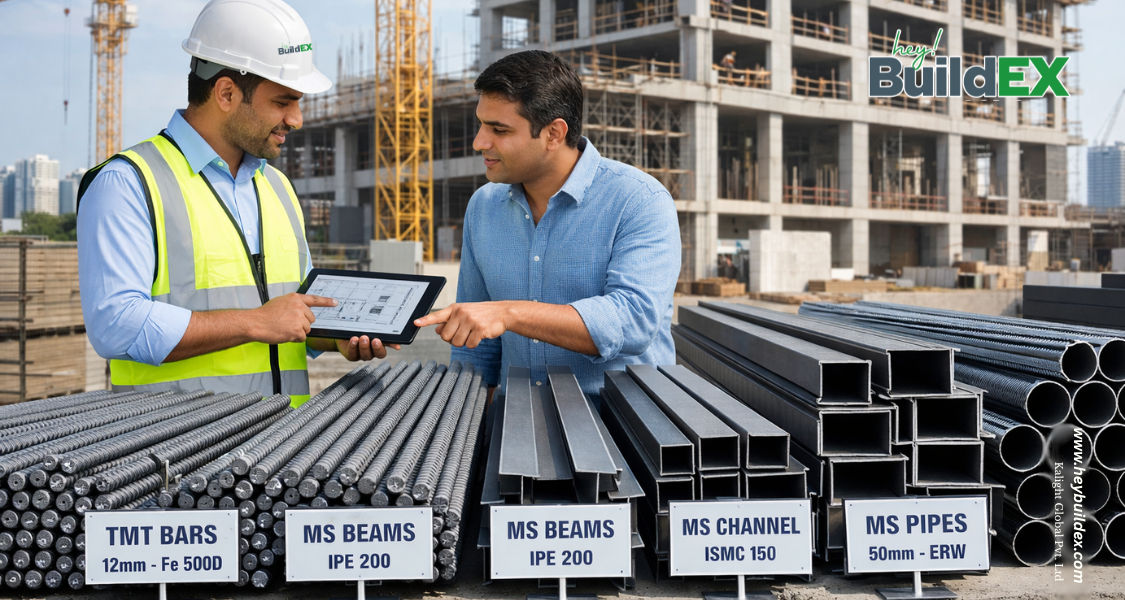
TMT bars are the most widely used reinforcement steel in India. They are ideal for residential construction, commercial buildings, and infrastructure projects. Their combination of a hard outer surface and a soft, ductile core makes them perfect for earthquake-resistant steel bars. This is why the TMT bars selection guide is one of the most searched topics by Indian builders.
Structural steel is used in columns, beams, trusses, and frames for large commercial and industrial projects. High strength steel for construction projects like bridges, warehouses, and multi-storey buildings typically relies on structural steel sections manufactured per IS 2062 standards.
For coastal constructions, water treatment plants, or marine infrastructure, corrosion-resistant steel construction materials are essential. Using standard TMT bars in these environments without special treatment will lead to rust and structural degradation within a few years.
Used primarily in pre-stressed concrete structures like bridges and flyovers, these offer extreme tensile strength beyond ordinary reinforcement steel.
Steel grades in India are defined by the Bureau of Indian Standards (IS 1786). The grade number represents the minimum yield strength of the steel in megapascals (MPa). Here is a quick breakdown to help you select the right TMT bars:
| Feature | Fe 415 | Fe 500 | Fe 550 | Fe 600 |
|---|---|---|---|---|
| Yield Strength | 415 MPa | 500 MPa | 550 MPa | 600 MPa |
| Best Use | Light structures | Residential & commercial | High-rise buildings | Bridges & heavy infra |
| Ductility | High | High | Moderate | Moderate |
| Earthquake Resistance | Good | Excellent | Good | Moderate |
| Weldability | Excellent | Very Good | Good | Moderate |
| Cost | Low | Moderate | Higher | Highest |
| IS Standard | IS 1786 | IS 1786 | IS 1786 | IS 1786 |
For most residential construction projects — independent houses, apartments, and small commercial buildings — Fe 500 TMT bars are the optimal choice. They offer the best balance of strength, ductility, earthquake resistance, and cost-efficiency. For high-rise buildings and industrial structures, Fe 550 or Fe 600 grades offer the extra muscle needed.
The Fe 500 vs Fe 550 steel debate boils down to your structural design requirements. Always consult your structural engineer before finalizing the grade — using a higher grade than required wastes money, while using a lower grade compromises safety.
Knowing how to select TMT bars correctly can save you from costly mistakes down the road. Follow these expert-recommended steps:
The steel requirements differ significantly between steel for residential construction and steel for commercial construction. A single-floor home has different load requirements compared to a 10-storey apartment building. Identify your project category first.
Always insist on TMT bars that comply with IS 1786:2008 standards. This is non-negotiable for construction steel standards in India. Uncertified steel may be cheaper but poses severe safety risks and may not pass structural inspections.
TMT bars with a proper transverse rib pattern provide better bonding with concrete. Poor rib patterns reduce the grip between steel and concrete, weakening your structure over time.
If your project is in a coastal area, flood-prone zone, or a region with high humidity, opt for TMT bars with enhanced corrosion resistance. This is a critical factor in the reinforcement steel guide for long-term durability.
India has several high-seismic zones. Earthquake-resistant steel bars must have high elongation values — typically over 14.5% for Fe 500. This ductility allows the structure to absorb and dissipate energy during seismic events without sudden failure.
Steel quality for construction is only as reliable as the supplier. Choose suppliers who provide mill test certificates (MTC), third-party lab test reports, and transparent sourcing. Smart steel procurement tips for construction always start with choosing a verified, trustworthy source.
Different project types demand different steel solutions. Here is a practical reinforcement steel guide based on your specific context:
Use this quality steel for building projects checklist every time you procure construction steel:
With hundreds of steel suppliers in the market, why should HeyBuildex be your first choice for quality steel for building projects? Here is what sets HeyBuildex apart:
Here are some field-tested insights from experienced civil engineers to maximize the value of durable steel for long-lasting construction:
Choosing the right steel is not just a procurement decision — it is a structural safety decision that affects the lives of everyone who will live or work in your building. Whether you are comparing Fe 500 vs Fe 550 steel, looking for earthquake-resistant steel bars for a seismic zone, or searching for the best TMT bars for building a commercial complex, the answer always starts with knowledge and trusted sourcing.
Use this construction steel buying guide as your reference, follow the buyer's checklist, and always work with verified suppliers who prioritize quality, transparency, and your project's long-term success.
HeyBuildex is committed to being your most reliable partner in quality steel for building projects. From expert guidance on how to select TMT bars to doorstep delivery of IS-certified steel across India, we are with you every step of the way.
Fe 500 TMT bars are the most recommended grade for residential buildings. They offer the ideal combination of high strength, ductility, and earthquake resistance while remaining cost-effective for home construction.
Fe 500 has a yield strength of 500 MPa and is best for residential and small commercial projects. Fe 550 offers higher strength (550 MPa) and is preferred for high-rise buildings, making it costlier but necessary for heavier structural loads.
Always ask your supplier for the Mill Test Certificate (MTC) and confirm the IS 1786:2008 marking on the bars. You can also send samples to a government-approved lab for independent verification before use.
Fe 500D or Fe 550D TMT bars are ideal for seismic zones. The 'D' designation indicates enhanced ductility with elongation values above 16%, allowing the structure to flex and absorb seismic energy without sudden collapse.
No — different structural members have different load requirements. Foundations and columns typically need higher-grade steel like Fe 500 or Fe 550, while roof slabs may work fine with Fe 500, subject to your structural engineer's design.
Store TMT bars off the ground on wooden platforms in a covered area. Avoid prolonged exposure to moisture or rain. Light surface rust that wipes off is acceptable, but bars with deep pitting or flaky rust should be rejected.
Absolutely. In coastal or high-humidity environments, standard TMT bars can begin corroding within 3–5 years. CRS (Corrosion Resistant Steel) or epoxy-coated bars may cost 10–15% more upfront but save you significantly on repairs and structural rehabilitation over the building's lifetime.
On average, a 1000 sq ft residential house requires approximately 3.5 to 4.5 MT (metric tons) of TMT steel, depending on the number of floors, design complexity, and local soil conditions. Your structural engineer can provide the exact quantity from the bar bending schedule.
Verify the bar diameter, grade markings, and weight per meter against the invoice and IS standards. Inspect for surface defects, check that the MTC matches the delivered batch, and reject any bars that show signs of deep rust, bends, or dimensional inconsistencies.
HeyBuildex provides IS-certified steel with full documentation, transparent pricing, and expert guidance — things many local suppliers cannot guarantee. With pan-India delivery, dedicated support, and verified sourcing, you get peace of mind along with quality steel for every project.