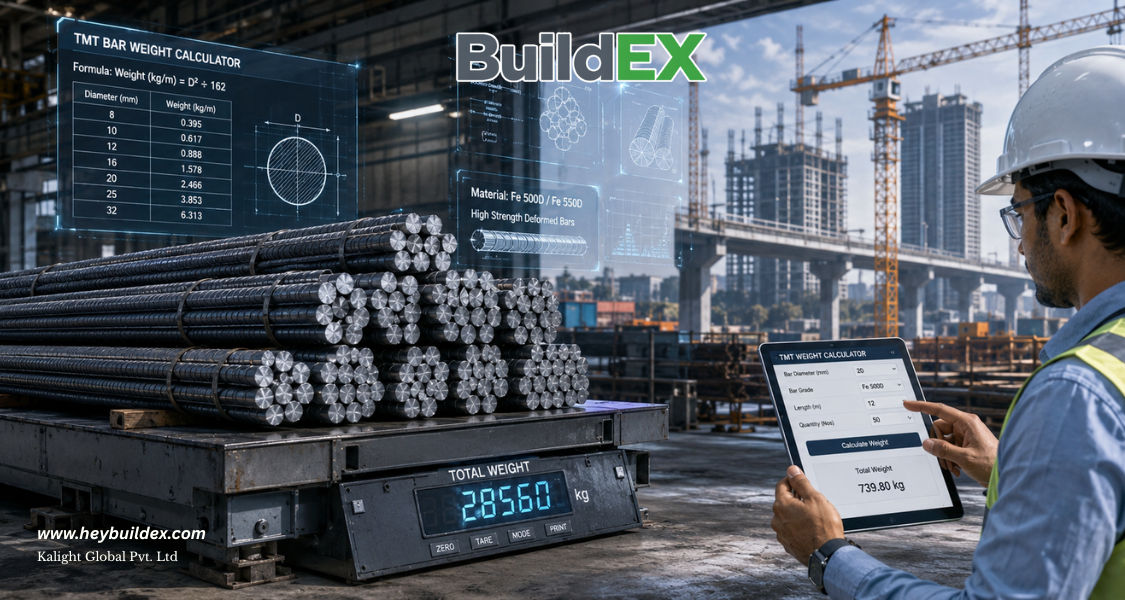
Complete Size-Wise Guide for Contractors, Engineers & Home Builders
If you are building a house, a commercial complex, or a large infrastructure project, knowing your TMT bar weights accurately is one of the most important steps before you place a steel order. The right TMT bar weight chart saves you from over-buying (wasted money) or under-buying (project delays). This guide gives you everything in one place: a clear weight table, the calculation formula, size-wise applications, and smart procurement tips
Every kilogram of steel you buy costs money. When your structural consultant or site engineer asks for '200 running meters of 12mm TMT bar', do you know how many kilograms that is? Most site supervisors and procurement managers rely on TMT bar weight charts to convert bar lengths into kilograms or tonnes — because steel suppliers price by the kilogram or tonne, not by the meter.
In this guide you will find the standard TMT bar weight chart for 2026, the universally accepted steel weight formula, step-by-step calculation examples, a size-wise application guide, and a comparison of Fe 500D vs Fe 550D grades. Whether you are a homebuilder in Vijayawada, a contractor in Hyderabad, or a quantity surveyor in Visakhapatnam, this resource is designed to make your steel estimation fast and accurate.
TMT (Thermo-Mechanically Treated) bars are the backbone of reinforced concrete construction. They go inside columns, slabs, beams, and footings to handle the tensile stresses that concrete alone cannot resist. These bars come in a range of diameters — from slim 6mm bars used in partition walls to heavy 32mm bars used in large columns and industrial structures.
The challenge is that steel is sold by weight (kilograms or metric tonnes), but engineers specify it by diameter and length. A TMT bar weight chart bridges that gap. Instead of calculating each diameter manually every time, you simply look up the standard weight per metre and multiply by the length you need.
Why Is the Weight Chart Important?
The following table lists the standard weight for each TMT bar diameter based on the IS 1786 standard and the D²/162 formula (explained in Section 3). These values are consistent across all BIS-certified manufacturers.
| Diameter (mm) | Weight Per Metre (kg) | Weight Per 12m Bar (kg) | Approx. Bars Per MT |
|---|---|---|---|
| 6 mm | 0.222 | 2.664 | 375 bars |
| 8 mm | 0.395 | 4.740 | 211 bars |
| 10 mm | 0.617 | 7.404 | 135 bars |
| 12 mm | 0.888 | 10.656 | 94 bars |
| 16 mm | 1.580 | 18.960 | 53 bars |
| 20 mm | 2.470 | 29.640 | 34 bars |
| 25 mm | 3.858 | 46.296 | 22 bars |
| 32 mm | 6.320 | 75.840 | 14 bars |
Note on Weight Tolerances
BIS (Bureau of Indian Standards) IS 1786 permits a weight tolerance of ±2.5% for individual bars and ±1.5% for bundles. This means a 12mm bar may weigh slightly more or less than 0.888 kg/m. Always ask your supplier for the Mill Test Certificate (MTC) to confirm the exact unit weight of the batch you are purchasing.
Weight (kg/m) = D² ÷ 162
Where D = Diameter of the TMT bar in millimetres
This formula is derived from basic physics. Steel has a density of approximately 7850 kg per cubic metre. When you calculate the volume of a circular steel bar of diameter D (in mm) for 1 metre of length and multiply by density, you arrive at D²/162.
The beauty of this formula is that it works for any diameter without needing to look up a table. Memorise it once and you can calculate bar weights anywhere on site.
Quick Formula Verification
| Bar Diameter | Calculation (D² ÷ 162) | Result (kg/m) | Matches Chart? |
|---|---|---|---|
| 8 mm | 64 ÷ 162 | 0.395 kg/m | Yes |
| 12 mm | 144 ÷ 162 | 0.888 kg/m | Yes |
| 16 mm | 256 ÷ 162 | 1.580 kg/m | Yes |
| 20 mm | 400 ÷ 162 | 2.469 kg/m | Yes |
| 25 mm | 625 ÷ 162 | 3.858 kg/m | Yes |
Once you know the formula, calculating TMT bar weight for any project is straightforward. Here are two real-world construction examples.
Scenario
A structural engineer specifies 12mm TMT bars at 150mm spacing for a roof slab. The slab is 10m x 8m. You need to estimate the total weight of steel required.
Scenario
You are building 4 RCC columns using 16mm TMT bars. Each column requires 6 vertical bars of 3-metre length.
Pro Tip for Site Engineers
Always add 5% to 8% wastage allowance to your calculated steel quantity to account for cutting losses, lapping lengths, bends, and hooks. This prevents material shortfalls during construction.
Each TMT bar diameter serves a specific structural purpose. Using the wrong size can either over-engineer your structure (wasting money) or compromise structural safety. Here is a quick guide to each standard size.
The lightest structural bar in common use. Used for distribution reinforcement in slabs, stirrups in beams and columns for low-load structures, mesh reinforcement in walls, and fencing. Not suitable as the primary load-bearing bar in any structural member.
A versatile bar for residential construction. Commonly used as secondary reinforcement in slabs, stirrups in medium-duty beams and columns, reinforcement in lintels and chajjas, and light-duty footing mats. A very commonly specified bar in G+1 and G+2 residential construction in Andhra Pradesh and Telangana.
The most popular bar size for home construction in South India. Used as the main bar in RCC slabs for residential buildings, secondary bars in beams, vertical bars in partition walls, and column reinforcement for single-storey structures. When people say 'house construction steel', they usually mean 12mm bars.
The go-to bar for structural columns and main beams. Used as primary reinforcement in columns for G+1 to G+3 structures, main bars in beams carrying significant loads, foundation reinforcement in medium commercial structures, and retaining walls. A 16mm bar has nearly double the weight of a 10mm bar — this reflects its significantly higher load-carrying capacity.
For high-rise residential and commercial projects. Used in columns of multi-storey buildings (G+4 and above), main beams in commercial complexes, pile caps and raft foundations, and industrial floor slabs. Primarily seen in urban construction in cities like Hyderabad, Visakhapatnam, and Vijayawada.
Specialist bar for heavy civil engineering. Found in bridge girders, large industrial columns, heavily loaded transfer beams, and deep foundation piles. Requires heavier bending equipment and is handled by specialist fabricators.
The heaviest standard bar used in major infrastructure work. Used in flyovers, large bridges, industrial buildings, power plants, and other major civil engineering structures. One 12-metre bar weighs 75.84 kg — handling requires lifting equipment on site.
| Bar Size | Recommended Use in House Construction | Grade Recommended |
|---|---|---|
| 8mm | Stirrups in beams and columns; secondary mesh in slabs | Fe 500D |
| 10mm | Secondary slab bars; lintels; small column stirrups | Fe 500D |
| 12mm | Main slab reinforcement; secondary beams | Fe 500D |
| 16mm | Column vertical bars; main beams | Fe 500D / Fe 550D |
| 20mm | Columns in multi-storey extensions; raft foundation | Fe 550D |
A common house construction project in India typically uses 60-70% of steel in 10mm and 12mm bars, with 20-25% in 16mm bars and the rest in 8mm stirrups. Your structural consultant will provide the exact Bar Bending Schedule (BBS) based on your site conditions and local building codes.
Steel quantity estimation — also called a Bar Bending Schedule (BBS) — involves calculating the total weight of each bar size required for every structural member. Here is a simplified method for each key element.
Time-Saving Tip
Most projects in Andhra Pradesh and Telangana use a thumb rule of 3.5 to 4.5 kg of steel per sq ft of built-up area for residential buildings. While this is only a rough estimate, it is useful for initial budget planning. Always get a detailed Bar Bending Schedule from your structural engineer before placing orders.
In India, the two most widely specified TMT bar grades for construction are Fe 500D and Fe 550D — both covered under BIS IS 1786. Here is a clear comparison to help you choose the right grade.
| Feature | Fe 500D | Fe 550D |
|---|---|---|
| Yield Strength | Min. 500 MPa | Min. 550 MPa |
| Tensile Strength | Min. 545 MPa | Min. 585 MPa |
| Ductility (Elongation) | Min. 16% | Min. 14.5% |
| Carbon Content | Max. 0.25% (restricted) | Max. 0.28% (restricted) |
| Weldability | Excellent | Good |
| Seismic Resistance | Very High | High |
| Best Use | Houses, apartments, bridges | High-rise, industrial |
| Cost | Standard pricing | Approx. 5-8% higher |
Which Grade Should You Choose?
For most residential construction in Andhra Pradesh and Telangana — including houses, villas, and low-rise apartments up to G+4 — Fe 500D is the recommended and most commonly specified grade. Its higher ductility (ability to bend before breaking) makes it particularly suitable for seismic zones. Fe 550D is preferred for structures where higher loads demand greater strength, such as commercial high-rises and industrial buildings.
Getting your TMT bar weight calculation right is not just a number exercise — it has real consequences for your project budget, timeline, and structural safety.
| If You Under-Calculate | If You Over-Calculate |
|---|---|
| Material shortage mid-project causes delays | Unnecessary capital locked in excess inventory |
| Emergency purchases at spot rates cost more | Handling and storage costs increase |
| Project timeline slips, labour costs rise | Risk of corrosion on stored steel |
| Structural member may be under-reinforced | Cash flow impacts for the developer |
In India, TMT bars are priced per kilogram or per metric tonne (MT = 1000 kg). Understanding the weight-to-price relationship helps you evaluate supplier quotes accurately.
Key Pricing Concepts
| Pricing Term | What It Means | How to Use It |
|---|---|---|
| Rate per kg | Price of one kilogram of TMT steel | Multiply by total kg needed for material cost |
| Rate per MT | Price per 1000 kg (metric tonne) | Divide total kg by 1000, then multiply by rate |
| Base price | Ex-mill price without GST or freight | Add 18% GST + freight to get landed cost |
| Landed cost | Total cost including GST, freight, unloading | Use this for actual budget calculations |
| Binding weight | Actual weight of the batch delivered | Cross-check against Mill Test Certificate (MTC) |
Pricing Formula for Site Managers
Total Steel Cost = (Total Weight in kg) × (Rate per kg including GST and freight)
Example: If you need 5,000 kg of 12mm Fe 500D TMT bars and the landed rate is ₹72 per kg, your total material cost = 5,000 × 72 = ₹3,60,000.
Always get at least 3 supplier quotes and verify the landed cost, not just the base rate.
Transportation cost is a significant factor in Andhra Pradesh and Telangana. Steel sourced locally from suppliers in Vijayawada, Hyderabad, or Visakhapatnam typically costs less to transport than steel sourced from distant mills — a key advantage of working with regional suppliers like HeyBuildex.
Your steel supplier is as important as the grade you specify. Here is what to check before placing a bulk order.
7 Things to Verify Before Buying TMT Bars
Buildex is a trusted construction materials supplier serving the building and infrastructure sector across Andhra Pradesh and Telangana. With deep regional expertise and a wide product portfolio, Buildex supports contractors, developers, and builders with reliable supply and competitive pricing.
Products Available
| Product Category | Products | Key Grades / Specifications |
|---|---|---|
| TMT Bars | All diameters 6mm to 32mm | Fe 415, Fe 500, Fe 500D, Fe 550D |
| Structural Steel | MS Beams, Channels, Angles, Flats | IS 2062 E250 / E350 |
| MS Pipes | ERW Black, GI Pipes | IS 1239 / IS 3589 |
| Non-Ferrous Metals | Copper Wire Rods, Copper Cathodes | High conductivity grades |
| Aluminium Products | Aluminium Sections, Profiles | Various alloys |
Service Areas
Why Builders in Andhra Pradesh and Telangana Choose HeyBuildex
Quick delivery to project sites across AP and Telangana | BIS-certified materials with MTC on every order | Competitive bulk pricing | Single-window supply for steel, pipes, and non-ferrous metals | Expert guidance on grade selection and quantity estimation
Accurate TMT bar weight calculation is the foundation of smart construction planning. Whether you are a homebuilder in Vijayawada checking your contractor's steel order, a procurement manager in Hyderabad placing a bulk purchase, or a site engineer in Visakhapatnam verifying a delivery — the TMT bar weight chart and the D²/162 formula are tools you will use throughout your project.
To recap the essentials: The standard formula Weight (kg/m) = D² ÷ 162 works for all bar sizes. The most used residential bars are 10mm, 12mm, and 16mm. Fe 500D is the recommended grade for most South Indian residential and commercial construction. Always verify weights against the Mill Test Certificate (MTC) from your supplier. Add 5-8% wastage when estimating quantities for procurement.
For your next construction project in Andhra Pradesh or Telangana, contact Buildex for reliable supply of BIS-certified TMT bars, structural steel, and other construction materials — with competitive pricing, fast delivery, and technical support for your procurement needs.
Planning your next project? HeyBuildex supplies TMT Bars, Structural Steel, MS Pipes, Copper Products, and Aluminium Products across Andhra Pradesh and Telangana.
Reach out to us for bulk pricing, MTC documentation, and doorstep delivery to your project site.
Answer
A 12mm TMT bar weighs 0.888 kg per running metre. A standard 12-metre bar weighs 10.656 kg. This is calculated using the formula D²/162, where D is the bar diameter in millimetres: 12² = 144, divided by 162 = 0.888 kg/m.
Answer
Use the formula: Weight (kg/m) = D² ÷ 162, where D is the bar diameter in millimetres. For example, for a 16mm bar: 16² = 256, divided by 162 = 1.58 kg per metre. Multiply this by the bar length to get the weight of a single bar.
Answer
The standard formula is Weight (kg/m) = D² ÷ 162, where D is the diameter in mm. This formula is based on the density of steel (7850 kg/m³) and applies to all standard TMT/rebar sizes. It is universally accepted by structural engineers and BIS-certified manufacturers.
Answer
An 8mm TMT bar weighs 0.395 kg per metre. For a standard 12-metre bar, the total weight is 4.74 kg. Calculation: 8² = 64, divided by 162 = 0.395 kg/m. These light bars are commonly used for stirrups and secondary reinforcement.
Answer
A 16mm TMT bar weighs 1.58 kg per metre. A standard 12-metre bar weighs 18.96 kg. Calculation: 16² = 256 ÷ 162 = 1.58 kg/m. The 16mm bar is widely used for columns and main beams in residential and commercial construction.
Answer
Standard TMT bar weights per metre range from 0.222 kg/m (6mm) to 6.320 kg/m (32mm). The most commonly used sizes are 0.617 kg/m for 10mm, 0.888 kg/m for 12mm, and 1.580 kg/m for 16mm bars. These are based on the IS 1786 standard and D²/162 formula.
Answer
The weight of a 12-metre TMT bar depends on its diameter. Examples: 8mm = 4.74 kg, 10mm = 7.40 kg, 12mm = 10.656 kg, 16mm = 18.96 kg, 20mm = 29.64 kg. Use the formula Weight = D²/162 multiplied by the bar length to calculate for any size.
Answer
The unit weight of TMT bars (weight per metre) is determined by the formula D²/162, where D is the diameter in mm. This is based on the density of steel at 7850 kg/m³. For 12mm bars, the unit weight is 0.888 kg/m. For 16mm bars, it is 1.580 kg/m.
Answer
For a standard residential house in India, a combination of bar sizes is used: 8mm for stirrups, 10mm for secondary slabs and lintels, 12mm for main slab reinforcement, and 16mm for column vertical bars. Fe 500D grade is recommended for residential construction due to its high ductility and seismic resistance.
Answer
To estimate steel quantity: (1) Prepare a Bar Bending Schedule (BBS) from structural drawings. (2) List the diameter, number, and length of each bar. (3) Apply the formula Weight = D²/162 x Length to get weight per bar. (4) Sum all bar weights and add 5-8% for wastage. (5) Convert to metric tonnes for supplier quotation.