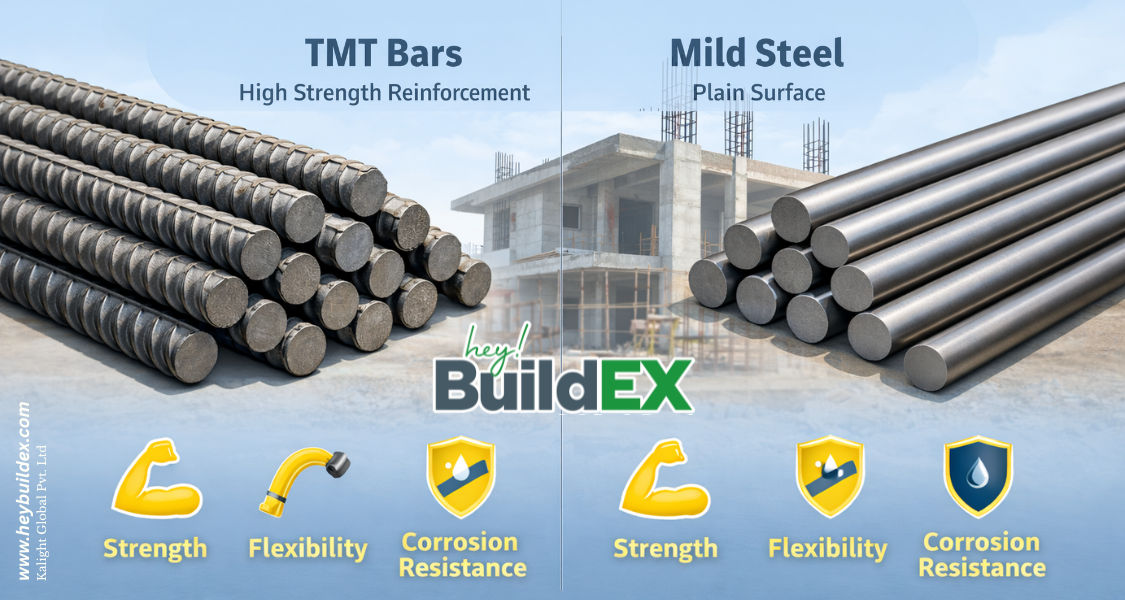
Steel plays a critical role in modern construction. Whether it is a residential building, commercial complex, bridge, or infrastructure project, choosing the right type of steel determines the strength, durability, and safety of the structure. Many people involved in construction often ask a common question: Are TMT bars considered mild steel?
The simple answer is No. While both are forms of steel used in construction, Thermo Mechanically Treated Bars (TMT bars) and Mild Steel (MS) are different in terms of manufacturing process, strength, properties, and application.
Understanding this difference is important for builders, contractors, engineers, and homeowners planning construction projects. This article explains the difference between TMT bars and mild steel, their uses, advantages, and why TMT bars are the preferred choice in modern construction.
TMT bars are high-strength reinforcement bars widely used in reinforced cement concrete (RCC) structures. These bars are manufactured using a special process called thermo-mechanical treatment, which gives them superior strength and flexibility.
In the manufacturing process, hot steel bars are passed through a rapid quenching system, where the outer surface cools quickly while the inner core remains hot. This process creates a strong outer layer and a flexible inner core, resulting in steel bars that can withstand heavy loads and stress.
Because of these properties, TMT bars are commonly used in:
Today, grades such as Fe500, Fe500D, and Fe550D are commonly used in India for construction purposes.
Mild steel, often referred to as MS steel, is a type of carbon steel that contains a low percentage of carbon (around 0.05% to 0.25%). Due to its low carbon content, mild steel is soft, ductile, and easy to fabricate.
Unlike TMT bars, mild steel is not primarily designed for structural reinforcement in concrete. Instead, it is widely used in fabrication and general engineering works.
Common applications of mild steel include:
Mild steel is easy to weld and shape, which makes it suitable for many fabrication tasks.
Understanding the differences between TMT bars and mild steel helps builders choose the right material for their projects.
In earlier decades, mild steel bars were sometimes used in construction as reinforcement. However, they were gradually replaced by TMT bars due to several advantages.
Higher Strength
TMT bars offer superior tensile strength, which allows structures to handle heavy loads more effectively.
Better Earthquake Resistance
The ductile core of TMT bars helps buildings absorb shock and vibration during earthquakes, making them safer.
Improved Bonding With Concrete
The ribbed design of TMT bars provides strong bonding with concrete, improving structural integrity.
Longer Lifespan
Due to their corrosion resistance and strength, TMT bars increase the lifespan of buildings and infrastructure projects.
In India, TMT bars are available in different grades based on their strength levels. The most commonly used grades include:
Builders often choose Fe500D or Fe550 for better safety and durability.
Selecting the right steel depends on the purpose of the project.
If the goal is structural reinforcement in concrete, TMT bars are the ideal choice because they provide:
If the requirement is fabrication or structural components, mild steel is suitable due to its ease of welding and shaping.
For any construction project, consulting engineers or trusted suppliers ensures that the correct steel grade and type are used.
The quality of TMT bars directly impacts the safety and durability of buildings. Using certified steel from trusted manufacturers ensures that the material meets required standards.
When purchasing TMT bars, buyers should check for:
Choosing the trusted supplier helps avoid low-quality materials that may compromise structural safety.
To summarize, TMT bars and mild steel are not the same. While both are types of steel, they serve different purposes in construction.
TMT bars are specifically designed for reinforced concrete structures, offering high strength, durability, and resistance to stress. Mild steel, on the other hand, is mainly used for fabrication and engineering applications.
Modern construction relies heavily on high-quality TMT bars to ensure that buildings remain strong, stable, and safe for decades.
Understanding the difference between these two materials helps builders, contractors, and homeowners make better decisions when selecting construction materials.