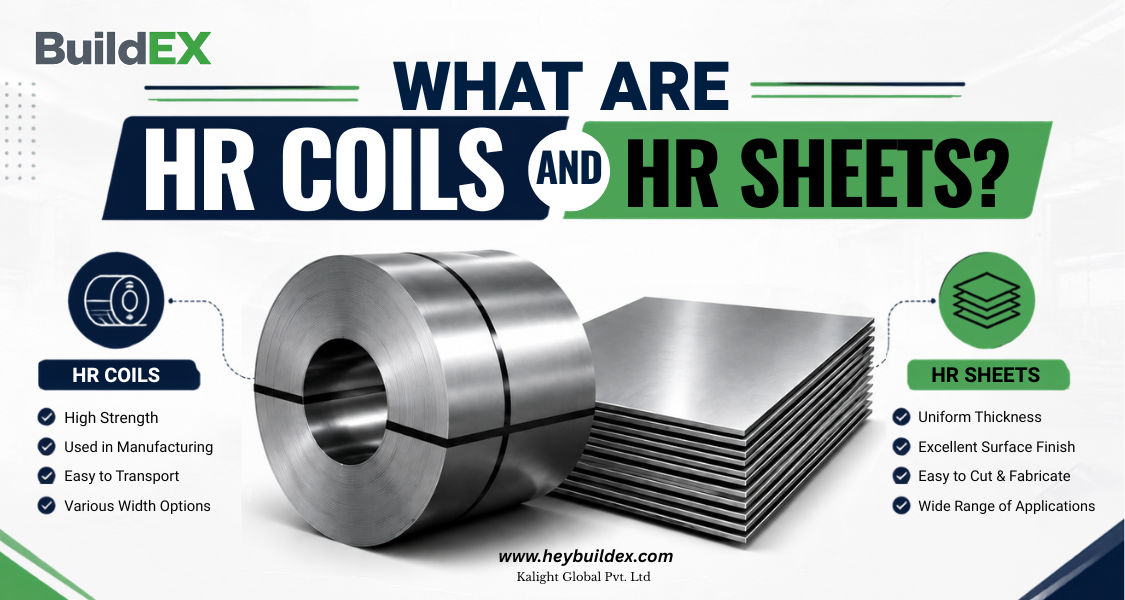
If you work in construction, fabrication, or manufacturing, you've almost certainly come across HR coils and HR sheets. These two hot rolled steel products form the backbone of everything from building frames to industrial machinery. But what exactly are they, how are they different, and which one should you buy for your project?
This guide breaks it all down in plain language — what HR coils and HR sheets are, how they're made, where they're used, how they're priced, and what to look for in a supplier. Demand for these products is rising fast across Andhra Pradesh, Telangana, and neighboring states as construction and industrial activity picks up in cities like Visakhapatnam, Vijayawada, Hyderabad, and Amaravati.
Hot rolled steel products account for a large share of the structural steel consumed by Indian construction and fabrication industries, largely because they strike the right balance between strength, workability, and cost. Unlike cold rolled or coated steel, HR coils and HR sheets don't require the extra processing steps that push up price — making them the practical, budget-friendly choice for structural framing, machinery bodies, and general fabrication work.
Regional demand is a big part of this story. Port-linked industrial hubs like Visakhapatnam and Chennai see steady HR coil consumption for pipe manufacturing and heavy fabrication, while fast-growing construction markets such as Vijayawada, Amaravati, and Hyderabad are driving demand for HR sheets in building frames, warehouses, and infrastructure projects. Bangalore's manufacturing and engineering base adds further pull for both products across automotive and industrial equipment applications.
HR (Hot Rolled) coils are continuous strips of steel that are rolled at very high temperatures and then wound into large coils for easy storage, transport, and processing.
Steel slabs are heated above their recrystallization temperature and passed through a series of rollers that reduce their thickness and stretch them into long strips. Once rolled, the hot strip is cooled and coiled — hence the name 'hot rolled coil.'
Because HR coils are easier and cheaper to produce than cold rolled steel, they're the go-to choice when tight surface finish isn't critical but strength and cost-efficiency matter.
HR coils are supplied in a range of grades to match different structural and manufacturing needs. Commercial grades like SAE 1006–1010 are chosen for general fabrication where formability matters most, while structural grades such as IS 2062 are specified for load-bearing applications like beams, columns, and heavy frames. Higher-strength low-alloy (HSLA) grades are also available for applications that need extra strength without added weight.
Their industrial importance goes beyond raw strength. Because HR coils can be re-rolled, slit into narrower strips, or further processed into cold rolled or galvanised products, they act as a base material for much of the downstream steel industry — from pipe mills to appliance manufacturers. This makes coil availability and pricing a bellwether for the broader steel supply chain.
HR sheets are essentially HR coils that have been uncoiled and cut into flat sheets of specific lengths and widths, ready to use in fabrication and construction projects.
Once a hot rolled coil is produced, it can be sent through a cut-to-length line where it's straightened and sliced into flat sheets. This makes HR sheets more convenient for jobs that need flat, pre-sized pieces instead of a continuous roll.
HR sheets have the same rough, slightly oxidized surface as HR coils. They typically range from about 1.2 mm to 25 mm in thickness, though heavier gauges are available for structural applications.
For fabricators running one-off jobs or small batch production, HR sheets remove the need for uncoiling and straightening equipment on-site. A structural fabricator building a handful of machine bases or a contractor cutting base plates for a foundation typically finds HR sheets far more practical than ordering a full coil and processing it in-house — even though the raw material cost per tonne is marginally higher.
The biggest difference between the two comes down to form. HR coils are continuous rolled strips, while HR sheets are flat, pre-cut pieces. Here's a side-by-side comparison:
| Feature | HR Coil | HR Sheet |
|---|---|---|
| Form | Continuous rolled strip | Flat, pre-cut pieces |
| Thickness | 1.2 mm – 20 mm (typical) | 1.2 mm – 25 mm (typical) |
| Applications | Pipe making, re-rolling, slitting | Direct fabrication, tanks, structures |
| Handling | Needs uncoiling equipment | Ready to use, easier to handle |
| Cost | Slightly lower per tonne | Slightly higher (processing added) |
The hot rolling process follows a consistent sequence from raw material to finished coil:
This process gives hot rolled steel its characteristic strength and workability, making it ideal for applications where dimensional precision matters less than raw strength and cost.
Buyers often confuse hot rolled (HR) and cold rolled (CR) steel. Here's how they compare:
| Feature | HR Product | CR Product |
|---|---|---|
| Surface Finish | Rough, scaled | Smooth, polished |
| Accuracy | Looser tolerance | Tight dimensional tolerance |
| Strength | High, less ductile | More ductile, formable |
| Cost | Lower | Higher (extra processing) |
| Applications | Structural, heavy fabrication | Appliances, automotive panels |
| Width | Thickness |
|---|---|
| 900 – 1,600 mm | 1.2 – 20 mm |
| 1,250 mm (standard) | 2.5 – 12 mm (most common) |
| Length | Width | Thickness |
|---|---|---|
| 2,000 – 12,000 mm | 1,000 – 2,500 mm | 1.2 – 25 mm |
| 2,500 mm (standard) | 1,250 mm (standard) | 3 – 16 mm (most common) |
From high-rise construction in Hyderabad to industrial fabrication units in Visakhapatnam, HR coils and HR sheets remain the material of choice wherever strength, availability, and cost-efficiency matter more than a polished finish. In Vijayawada and Amaravati, where infrastructure development is accelerating, HR sheets are increasingly specified for warehouse roofing structures, prefabricated building components, and industrial shed frameworks, while HR coils continue to feed regional pipe and re-rolling mills.
It's worth remembering that under-specifying thickness to save cost upfront often leads to higher costs later — through reinforcement work, rework, or premature wear. A short conversation with your supplier's technical team before finalising an order can save significant rework down the line, especially for load-bearing or safety-critical components.
HR coil price and HR sheet price fluctuate based on several factors:
Because prices move frequently with market conditions, it's best to request a live quotation from your supplier rather than relying on older reference prices. For large or phased projects, many buyers lock in pricing for bulk quantities in advance or negotiate rate contracts to protect against short-term volatility — a strategy worth discussing with your supplier if your project spans several months.
A dependable supplier can make or break your project timeline. Look for:
Buildex supplies a full range of steel and construction materials, including HR coils, HR sheets, TMT bars, structural steel, MS beams, MS channels, MS angles, MS pipes, aluminium products, and copper products.
We serve construction companies, fabricators, and industrial buyers across Visakhapatnam, Hyderabad, Vijayawada, Amaravati, Chennai, and Bangalore — offering bulk supply, competitive pricing, fast delivery, and dedicated support for large-scale industrial projects.
HR coils and HR sheets are essential materials across construction, fabrication, and manufacturing. While HR coils offer flexibility for further processing, HR sheets provide ready-to-use flat steel for direct fabrication. Choosing the right product comes down to your application, required thickness, and supplier reliability.
Need HR coils or HR sheets for your next project? Contact BuildEX today for competitive quotations, technical specifications, and bulk steel supply support across Andhra Pradesh, Telangana, and beyond.
HR coils are continuous rolled steel strips wound into rolls, while HR sheets are flat pieces cut from those coils to fixed lengths. Coils suit further processing; sheets are ready for direct use.
HR coils are used for pipe manufacturing, re-rolling into other steel products, slitting into narrower strips, and various construction and fabrication applications.
HR sheets are used directly in construction, storage tank fabrication, machinery bodies, and structural components where flat, ready-to-use steel is needed.
Neither is universally 'better' — HR coils suit structural and heavy-duty applications, while CR coils suit precision parts needing a smooth finish and tight tolerances.
Choose HR sheets for cost-effective structural and industrial use; choose CR sheets when a smooth surface and precise thickness are essential, such as appliance panels.
Steel slabs are reheated above 1,700°F and rolled through mills to reduce thickness, then cooled and wound into coils.
Match the grade and thickness to your load requirements, confirm tolerances, request mill test certificates, and choose a supplier with reliable bulk stock.
Select thickness based on your application's load and use case, verify flatness for welding accuracy, and confirm the grade meets your design specification.
HR coils typically range from 900–1,600 mm in width and 1.2–20 mm in thickness. HR sheets commonly range 2,000–12,000 mm in length, 1,000–2,500 mm in width, and 1.2–25 mm in thickness.