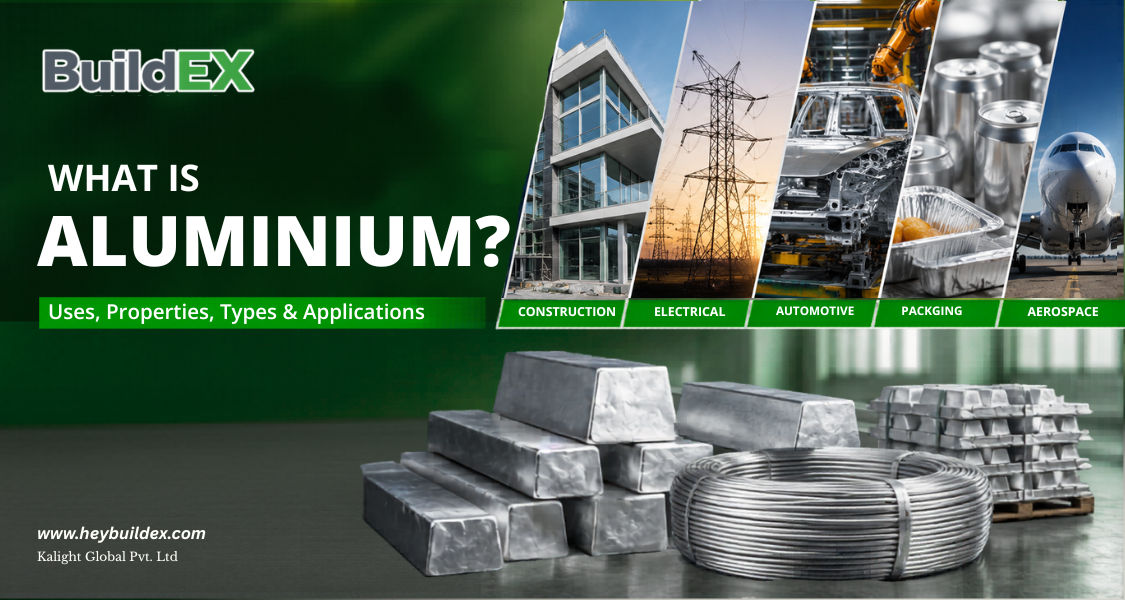
Think about your morning. You wake up, open an aluminium-framed window. You pop your breakfast in a foil-lined container. You drive to work in a car whose engine block is cast from aluminium alloy. At the office, power runs through aluminium cables strung across transmission towers outside. And somewhere above you, a commercial aircraft — mostly aluminium — is cruising at 35,000 feet.
Aluminium is one of the most remarkable materials ever put to industrial use. Yet most people know surprisingly little about it. What exactly is it? Why is it used so widely? And what makes it different from other metals?
This guide answers all of those questions in plain, straightforward language — no chemistry degree required. Whether you are a procurement professional, a student, a construction specifier, or just curious, you will find everything you need right here.
Aluminium (chemical symbol Al, atomic number 13) is a silvery-white metal that is soft, light, and incredibly easy to work with. It is the most abundant metal on Earth — making up about 8% of the planet's crust — yet you will never find it lying around as a pure metal in nature. It is always chemically bonded to other elements, mainly in a reddish rock called bauxite.
In simple terms: Aluminium is a lightweight, naturally corrosion-resistant metal that can be shaped into almost anything, conducts electricity well, and can be recycled endlessly — which is why industries around the world rely on it every single day.
To get usable aluminium, manufacturers first refine bauxite into a white powder called alumina, and then pass a powerful electric current through it to separate the pure metal. The result is the versatile, shiny aluminium we use in thousands of products.
Here is a clear, no-jargon breakdown of aluminium's most important properties — and what each one actually means in the real world.
| Property | What It Means | Why It Matters to You |
|---|---|---|
| Lightweight | 3x lighter than steel (2.7 g/cm³) | Lower shipping costs, easier installation, better fuel economy in vehicles |
| Corrosion Resistant | Forms its own protective oxide skin | Lasts for decades outdoors with no painting or coating needed |
| Conducts Electricity | Carries 61% of copper's current at 30% of the weight | Cheaper and lighter cables and wiring for power grids |
| Conducts Heat | Dissipates heat quickly and evenly | Great for cookware, heat sinks, and radiators |
| Easy to Shape | Can be rolled, bent, extruded, or cast | Manufacturers can make almost any shape or profile from it |
| 100% Recyclable | Can be melted and reused forever | Cuts energy use by 95% and reduces landfill waste |
| Strong for Its Weight | High tensile strength relative to mass | Builds strong structures without heavy foundations |
| Food Safe | Does not leach chemicals | Safe for food packaging, cans, and pharmaceutical foils |
Aluminium weighs about 2.7 grams per cubic centimetre. To put that in perspective, steel weighs around 7.9 g/cm³. That means for the same volume of metal, steel is nearly three times heavier. In aviation, automotive, and construction, that difference is transformative. A lighter aircraft burns less fuel on every flight. A lighter car accelerates faster and emits less CO₂. A lighter building frame needs smaller, cheaper foundations.
Unlike some materials that degrade each time they are recycled, aluminium can be melted down and reformed into new products indefinitely — with zero loss in quality. And because recycling requires only 5% of the energy used to produce primary aluminium, it is both the environmentally responsible and financially sensible choice. In fact, nearly 75% of all aluminium ever produced is still in use today.
It is a fair question. After all, there are hundreds of materials engineers and manufacturers could choose from. So why does aluminium keep coming out on top? The honest answer is that no other common material ticks as many boxes at once:
Bottom line: Aluminium does not have just one great quality — it has several, all at once. That combination is what makes it irreplaceable in modern manufacturing.
Let us walk through the major industries that depend on aluminium, and explain exactly why they use it.
Walk past any modern commercial building and look at the window frames, curtain walls, and roofing details. Chances are, most of what you see is aluminium. Here is why the construction sector loves it:
India's ongoing urbanisation — with programmes like the Smart Cities Mission — is driving strong, sustained demand for aluminium across all construction segments.
Every time you switch on a light, electricity likely travels through aluminium at some point along its journey. The electrical industry is one of aluminium's biggest consumers, and for good reason:
When industries buy aluminium, they typically buy it in one of three primary product forms. Each serves a different purpose in the manufacturing chain.
Aluminium Ingot An aluminium ingot is a solid block of refined aluminium, typically weighing between 5 kg and 22 kg. Think of it as the raw ingredient that other manufacturers start with. Foundries buy ingots and melt them down to cast car parts, machinery components, and alloy products. They are easy to handle, stack neatly on pallets, and are the most common traded form of primary aluminium.
Aluminium T/Sow Ingot T-bar and Sow ingots are the big brothers of standard ingots. Each one can weigh anywhere from 500 kg to 1,000 kg. They are designed for large industrial operations that need to feed high-capacity furnaces efficiently. Handling them requires forklifts or overhead cranes, but the trade-off is lower handling costs per tonne at scale.
Aluminium Wire Rod Wire rod is aluminium that has been cast and hot-rolled into a continuous coil of round bar, typically 9 mm to 15 mm in diameter. Cable manufacturers buy these coils and draw them down through a series of dies to produce the thinner wires used in everything from household wiring to national power grids.
We supply Aluminium Ingot, Aluminium T/Sow Ingot, and Aluminium Wire Rod for industrial and commercial buyers across India and international markets. Our products meet international quality standards and are available for bulk procurement. Get in touch to discuss your requirements.
You do not need to be a metallurgist to understand this — here is the process in plain English.
Bauxite is a reddish-brown ore found in tropical and subtropical regions. Australia, Guinea, Brazil, and India are among the world's largest producers. The ore is dug up, crushed, and shipped to refineries.
At the refinery, bauxite is mixed with hot caustic soda under pressure, which dissolves the aluminium-bearing minerals and leaves the impurities (a sludge called red mud) behind. The solution is then cooled and processed to produce fine white alumina powder — essentially aluminium oxide (Al₂O₃).
This is where the magic happens. Alumina is dissolved in a bath of molten cryolite and subjected to a massive direct electric current. The electricity breaks the bond between aluminium and oxygen, and liquid aluminium collects at the bottom of the cell. It is then tapped off and cast into ingots, wire rod, or other product forms.
Scrap aluminium — from old cans, window frames, car parts, and industrial offcuts — is sorted, cleaned, and melted in a furnace. It takes about 95% less energy than primary production and produces aluminium of identical quality. This is why recycling aluminium is one of the most commercially and environmentally compelling processes in all of manufacturing.
Short answer: extremely bright. Several major global trends are converging to drive aluminium demand higher over the coming decades.
A typical electric vehicle contains 20 to 30% more aluminium than a conventional car. With EV adoption accelerating globally — and India setting ambitious targets — demand for high-quality aluminium in battery enclosures, lightweight chassis, and motor components is growing fast.
Every solar farm, wind turbine, and grid-scale battery installation uses significant quantities of aluminium. As governments around the world race to meet their net-zero commitments, aluminium consumption in the clean energy sector is projected to roughly double by 2040.
Modern green-certified buildings use aluminium extensively — in thermally broken window systems, ventilated facades, lightweight roofing, and modular construction systems. India's affordable housing and smart city programmes represent a long-term structural demand driver for aluminium.
Recycled aluminium is increasingly being marketed as a premium, low-carbon product — and buyers in Europe and North America are willing to pay for it. As sustainability reporting becomes mandatory for more companies, the provenance and carbon footprint of raw materials will matter more than ever.
India is now among the world's top five aluminium producers, with world-class integrated smelters and a fast-growing secondary processing sector. Demand from Southeast Asia, the Middle East, and Africa for Indian Aluminium Ingot and Wire Rod is rising steadily.
Aluminium is not glamorous in the way that gold or titanium might seem — but it is arguably more important to everyday life than either of them. It keeps your lights on, your buildings standing, your car moving, and your food fresh. And as the world shifts toward lighter, cleaner, and more sustainable ways of building and manufacturing things, aluminium's role is only going to grow.
Whether you are sourcing raw materials for a manufacturing operation, specifying products for a construction project, or simply trying to understand what makes this metal tick, we hope this guide has given you a clear and useful picture.
Looking for reliable supply of Aluminium Ingot, T/Sow Ingot, or Wire Rod? Buildex supply high-quality aluminium products for industrial and commercial buyers across India and international markets. Reach out today to discuss your requirements, get a quotation, or learn more about our product specifications.
Aluminium is a lightweight, silvery metal (symbol: Al) that makes up about 8% of Earth's crust. It is used in construction (windows, roofing, facades), electrical infrastructure (cables, transmission lines), automotive and aerospace manufacturing, packaging (foils, cans), and hundreds of other industrial and consumer applications.
Because it combines several valuable properties in one material: it is light, strong, corrosion-resistant, electrically conductive, easy to shape, and fully recyclable. No other common material does all five things at once, which makes aluminium the default choice across many industries.
The biggest advantages are: (1) light weight — about one-third the density of steel; (2) natural corrosion resistance — no rust, no maintenance; (3) electrical conductivity — cheaper and lighter than copper for most wiring applications; (4) malleability — easy to roll, extrude, cast, or draw into wire; and (5) recyclability — can be recycled endlessly using 95% less energy than primary production.
Aluminium is lightweight (reducing structural loads and foundation costs), weather-resistant (no rust even in coastal or humid environments), and low-maintenance (powder-coated finishes last decades). It is ideal for window frames, doors, curtain walls, roofing systems, and modular building structures.
The largest consumers are: construction and infrastructure, electrical power and energy, automotive and transportation, aerospace and defence, and packaging (food, beverage, and pharmaceutical). In India, construction and electrical infrastructure are the dominant demand drivers.
Aluminium does not rust (rust is specific to iron and steel). However, it does oxidise — but that is actually a good thing. The thin, transparent oxide layer that forms instantly on aluminium's surface acts as a protective barrier, preventing further corrosion. This is why aluminium is used outdoors and in marine environments without any additional coating.
The primary traded forms are: Aluminium Ingot (small blocks, 5–22 kg, used for casting and alloy production), Aluminium T/Sow Ingot (large-format blocks, 500–1,000 kg, for industrial re-melting), and Aluminium Wire Rod (hot-rolled coils, 9–15 mm diameter, used by cable manufacturers). Downstream products include sheets, foils, extrusions, tubes, and alloy billets.
Primary aluminium production involves two stages: the Bayer Process (bauxite ore is refined into alumina powder using caustic soda) and the Hall-Héroult Process (alumina is smelted via electrolysis to produce liquid aluminium). Secondary aluminium is made by re-melting scrap, using just 5% of the energy required for primary production.