
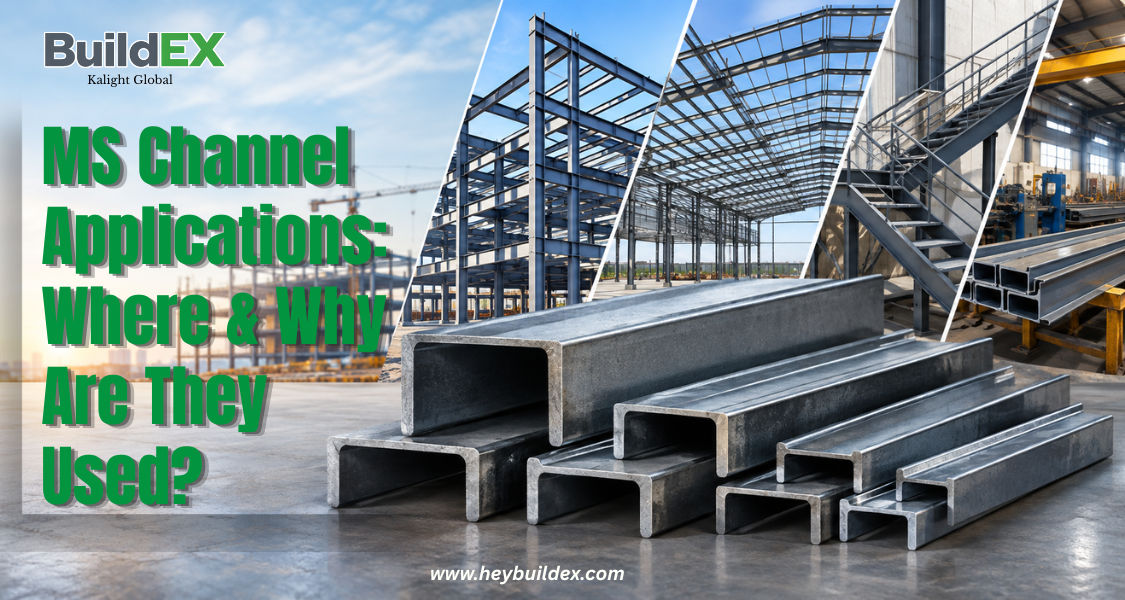
MS Channel Applications: Where & Why Are They Used?
An MS channel is a structural steel section with a channel-shaped profile that is commonly used to provide support, framing and reinforcement in construction, fabrication and industrial structures. Because of its C-shaped design, an MS channel offers a practical combination of strength and a manageable shape that is easy to cut, weld and fit into a wide range of structures.
MS channels have remained popular across construction and industrial sectors for several reasons: reliable strength for their weight, a practical shape that suits framing and support work, flexibility during fabrication, wide availability, and a broad range of sizes suited to different structural applications. This article looks at where MS channels are actually used, why builders and fabricators choose them, and what to check before buying one for a project.
What Is an MS Channel?
"MS" stands for mild steel, a low-carbon steel valued in construction for its workability, weldability and reasonable strength. An MS channel is a length of this steel rolled into a C or U-shaped profile, made up of a flat "web" (the base of the C) and two parallel "flanges" (the sides that turn upward at right angles).
This shape matters structurally. The flanges add depth and stiffness compared with a flat plate of the same weight, which is why channel sections resist bending more efficiently than flat steel strips. The open profile also makes it easy to bolt, weld or fit other members onto the flanges, which is why MS channels are so often chosen for framing and support roles rather than purely decorative ones.
It helps to understand how MS channels differ from related steel sections:
- MS Channel – C/U-shaped profile, commonly used for framing, support structures and fabrication work.
- MS Angle – L-shaped profile, typically used for bracing, edge support and lighter framing tasks.
- MS Beam – I or H-shaped profile, generally used where higher bending strength is required across longer spans, subject to engineering design.
Each section has a different geometry suited to different structural roles, so the choice between them should always be based on the specific design requirement rather than familiarity or price alone.
Why Are MS Channels Used?
MS channels are selected across construction and fabrication projects for a combination of practical and structural reasons:
- Structural support – their profile resists bending and can carry loads as part of a designed framework.
- Framing – the flat web and flanges make it easy to build rigid frames and support structures.
- Reinforcement – channels are often used to stiffen or reinforce other structural elements.
- Fabrication ease – the straight, uniform profile is simple to cut, drill and weld.
- Availability in different dimensions – MS channels come in a range of heights, widths and thicknesses, allowing selection based on the application.
- Adaptability – the same basic section can be used in construction, industrial sheds, platforms and equipment frames.
That said, suitability always depends on the specific design loads, section dimensions, material specifications and engineering requirements of the project. An MS channel that works well in one application may not be the right choice in another.
MS Channel Applications in Construction
MS channel uses in construction generally fall into several practical categories:
- Building framework – MS channels are used in selected structural and secondary framing applications, such as supporting partitions, mezzanine floors or equipment enclosures within a larger structure.
- Roof structures – channel sections can be used for roof-support frameworks where the design specifically calls for channel members, offering a rigid base for roof sheeting and associated fittings.
- Staircase fabrication – certain staircase frames and supporting members use MS channels because the profile provides a stable base for treads and stringers.
- Platform structures – industrial and utility platforms often rely on MS channels for their support framework, since the section can be fabricated into a rigid grid.
- Support frames – channels are commonly fabricated into frames and structural supports for equipment, tanks and machinery.
- Reinforcement and fabrication – in fabricated construction assemblies, MS channels are used wherever a channel-shaped section fits the structural and geometric requirement better than a flat plate or angle.
Across these MS channel uses in construction, the deciding factor is always whether the channel section matches the load path and geometry the design calls for.
MS Channel for Structural Applications
Within a structural system, MS channels are typically incorporated as:
- Support members that carry secondary loads within a larger frame
- Frames for equipment, enclosures or machinery bases
- Brackets that connect and support other structural components
- Base and support assemblies for platforms, tanks or panels
- Secondary structural components that work alongside primary beams and columns
- Industrial framework for sheds, racks and support systems
It's important to be clear that an MS channel is not a substitute for an engineered beam in every situation. Beams, channels and angles each have different bending and load characteristics, and the correct section should always be selected according to structural design requirements rather than appearance, habit or price alone. For any primary load-bearing application, the section size and specification should come from proper structural calculations, not a general assumption about channel strength.
MS Channel for Steel Fabrication
Fabricators frequently choose MS channels for a range of custom work, including:
- Equipment frames and enclosures
- Machine supports and mounting bases
- Work platforms and walkways
- Structural frames for panels and assemblies
- Industrial racks and storage structures
- Custom fabricated structures built to project-specific drawings
- Support assemblies for tanks, pipelines and machinery
MS channel for steel fabrication is valued for practical reasons: the straight profile is easy to measure and cut accurately, it welds well where the process and specification are appropriate, it is available in multiple sizes to match different load and space requirements, and its geometry makes it straightforward to combine with plates, angles and other channels into a finished assembly.
MS Channel for Roofing Structures
MS channel for roofing structure applications typically appears in the supporting framework rather than as the roofing surface itself. Common uses include:
- Roof support frames for sheds and industrial buildings
- Purlin-related fabrication where the design specifies channel sections
- Shed structures, including side and roof framing
- Industrial roofing frameworks for warehouses and factories
- Bracing and support assemblies that stabilise the roof structure
The exact section size and arrangement used in a roofing structure depend on several project-specific factors: the span being covered, the expected load (including material and maintenance loads), local wind conditions, the type of roofing material, and the overall structural design. Because these factors vary significantly from project to project, it is not appropriate to recommend a universal MS channel size for roofing — the correct choice should come from the structural design for that specific building.
MS Channel for Industrial Applications
MS channel for industrial applications covers a wide range of facilities and uses, including:
- Manufacturing facilities, where channels support machinery and process equipment
- Warehouses and industrial sheds, for both primary and secondary framing
- Equipment support structures for pumps, tanks and processing units
- Maintenance platforms and walkways around machinery
- Conveyor support frameworks
- Fabricated machinery structures and bases
- Storage and support structures for racking and stacking systems
Because industrial environments often involve dynamic loads, vibration, and specific safety requirements, these applications commonly require detailed engineering calculations and project-specific specifications rather than standard assumptions about section capacity.
MS Channel Uses in Different Industries
| Industry | Common Application |
|---|---|
| Construction | Structural/support frames |
| Fabrication | Custom steel frameworks |
| Industrial | Equipment and platform supports |
| Warehousing | Frames and support structures |
| Roofing | Roof-support assemblies |
| Manufacturing | Machine/support structures |
| Infrastructure | Selected fabricated structures |
These are common patterns of use rather than universal rules — the right application for any given project still depends on its specific structural requirements.
MS Channel Sizes and Dimensions
MS channels are manufactured in a range of heights, flange widths, web thicknesses, lengths and weights. This variety exists because different applications call for different levels of stiffness and load capacity, and because fabrication and transport considerations vary from project to project.
Size matters because a channel's height and thickness directly influence how much bending resistance and stiffness it offers. As a simple conceptual example, a larger channel section may be appropriate for a different load or span than a smaller section, but the correct choice must always be determined from the project's actual engineering requirements — not by assuming that a bigger section is automatically the safer or more economical choice. Because verified size charts vary by manufacturer and standard, buyers should confirm exact dimensions and weights directly with their supplier or engineer rather than relying on generic figures.
How to Choose the Right MS Channel?
A practical, step-by-step approach helps avoid costly mistakes:
- Understand the application – confirm whether the channel is needed for construction, roofing, fabrication or industrial use.
- Determine structural requirements – establish the expected load, span and support conditions.
- Check dimensions – confirm the required height, flange width and thickness for the application.
- Check material specification – confirm the required steel grade or specification for the project.
- Consider fabrication requirements – account for cutting, drilling and welding needs in advance.
- Check quantity – calculate the total project requirement before placing an order.
- Compare supplier quotations – compare price, quantity, delivery timelines and any applicable charges on a like-for-like basis.
- Verify quality – check test certificates, documentation and the physical condition of the material before accepting delivery.
MS Channel Price Factors
MS channel price is influenced by a combination of market and project-specific factors, including:
- Current steel market prices
- Channel dimensions and thickness
- Overall weight of the order
- Order quantity
- Manufacturing or sourcing costs
- Transportation to site
- Market demand at the time of purchase
- Delivery location
- Supplier margins
- Applicable taxes
Because of these variables, MS channel price should never be compared across suppliers without first confirming that each quotation is based on the same specification, dimensions and weight basis. A lower quoted price on a lighter or thinner section is not necessarily a better deal.
Common Mistakes When Buying MS Channels
Buyers and site teams often run into avoidable problems, such as:
- Choosing a channel based only on price
- Ignoring dimensions relevant to the application
- Not checking thickness carefully
- Comparing quotations for different specifications as if they were equal
- Ignoring transportation costs and timelines
- Ordering without first calculating the exact quantity needed
- Selecting an unsuitable section for the intended application
- Not consulting an engineer for structural applications
- Failing to verify supplier documentation and material certificates
Avoiding these mistakes generally comes down to one principle: confirm the technical requirement first, then shop for the best supplier that meets it — not the other way around.
MS Channel Applications: Quick Summary
| Application | Why MS Channel Is Used |
|---|---|
| Construction | Support and framing |
| Roofing | Structural/support framework |
| Fabrication | Easy-to-adapt steel section |
| Industrial structures | Equipment and platform supports |
| Warehouses | Framework and support assemblies |
| Machinery | Fabricated support structures |
Buy MS Channels from a Reliable Steel Supplier
Buildex supplies a range of construction and steel products, with MS channels available as one of the steel sections used for construction and fabrication requirements. Buyers can enquire based on their required channel dimensions, quantity, intended application, delivery location and overall project requirements, so that the material supplied matches the actual specification needed on site.
For projects in and around Andhra Pradesh, including Visakhapatnam, Vijayawada, Amaravati and Hyderabad, working with an MS channel supplier that understands local delivery logistics and project timelines can help avoid delays. As with any structural steel purchase, buyers are encouraged to confirm dimensions, specifications and documentation before finalising an order.
Frequently Asked Questions
1. What is an MS channel?
An MS channel is a mild steel structural section with a C or U-shaped profile, made up of a flat web and two flanges. It is used for support, framing and reinforcement in construction, fabrication and industrial structures, chosen for its practical shape and workability.
2. What are the main MS channel uses?
MS channels are mainly used for structural framing, support structures, reinforcement and fabrication work. Common uses include building framework, roof-support structures, staircases, platforms and equipment frames, with the specific application depending on project design requirements.
3. Where are MS channels used?
MS channels are used in construction, industrial facilities, warehouses, fabrication workshops and roofing structures. They typically appear as framing, support members or reinforcement within a larger structural system rather than as a standalone finished surface.
4. Why are MS channels used in construction?
MS channels are used in construction because their shape provides good stiffness for framing and support roles, they are easy to cut and weld, and they are available in a range of sizes. The final choice always depends on the project's specific structural requirements.
5. What are the common MS channel applications?
Common MS channel applications include building framework, roof-support structures, staircase fabrication, industrial platforms, equipment frames and general reinforcement work across construction and fabrication projects.
6. Can MS channels be used for roofing structures?
Yes, MS channels can be used in roofing structures for support frames, purlin-related fabrication and bracing, where the design specifies channel sections. The exact size and arrangement depend on span, load, wind conditions and the roofing material used.
7. What are MS channels used for in steel fabrication?
In steel fabrication, MS channels are used for equipment frames, machine supports, work platforms and custom structural assemblies. Fabricators favour the section because it is easy to cut, weld and combine with other steel members.
8. How do I choose the right MS channel size?
Choosing the right MS channel size starts with understanding the application and structural requirements, including load, span and support conditions. Dimensions, thickness and material specification should then be confirmed against those requirements, ideally with engineering input.
9. What factors affect MS channel price?
MS channel price is affected by steel market prices, section dimensions and thickness, order quantity, transportation costs, delivery location and supplier margins. Quotations should always be compared on the same specification and weight basis.
10. Are MS channels suitable for industrial applications?
MS channels are commonly used in industrial applications such as equipment support, platforms and conveyor frameworks. Because industrial settings often involve dynamic loads, these applications typically require project-specific engineering calculations rather than standard assumptions.